
 Continue with Apple
 Continue with Google
Easy Guide to Navigating KYC and Privacy at Crypto Casinos in 2026

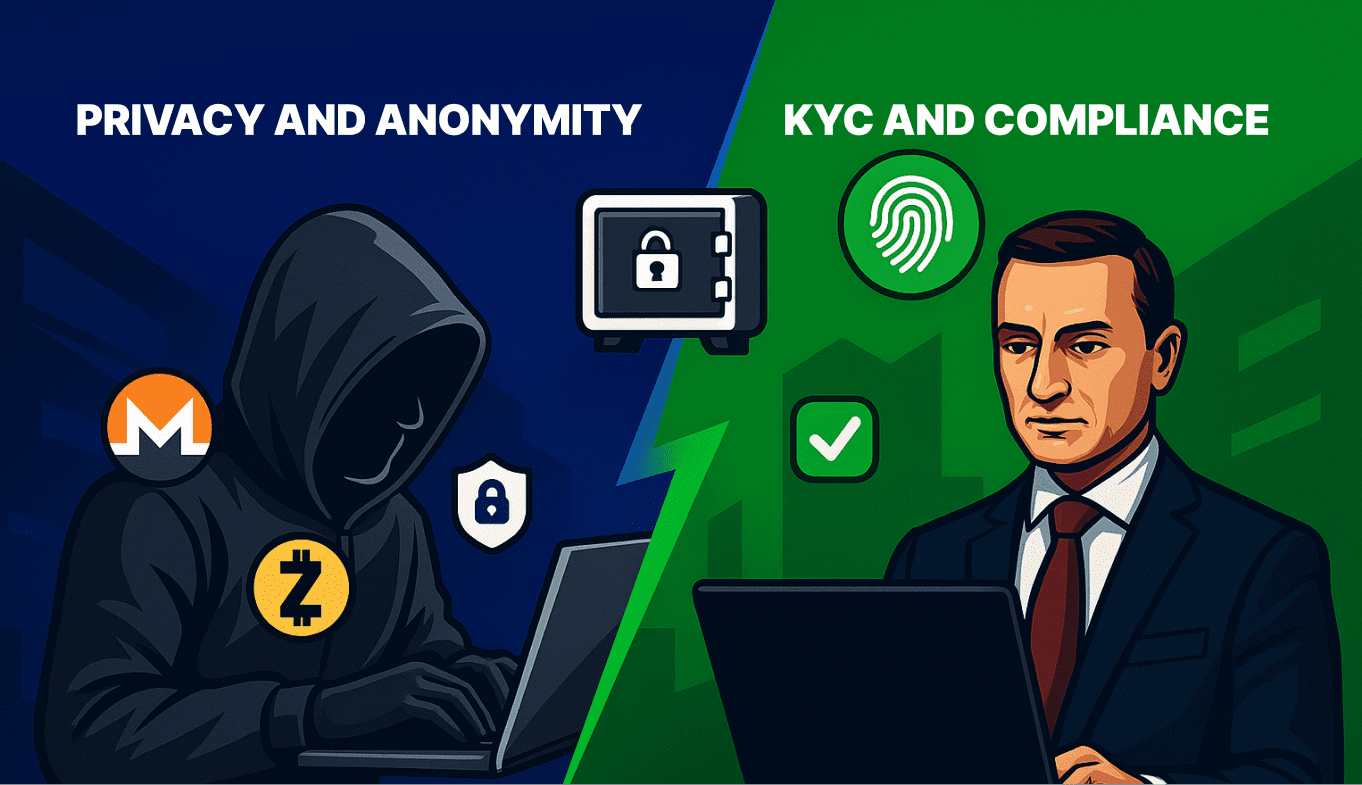
What you need to know about identity checks and crypto gambling
One of the biggest selling points of cryptocurrency and crypto gambling is anonymity. But evolving regulations are putting that under threat. In this original CoinBets guide, we’ll explore KYC and privacy issues at crypto casinos.
We’ll explain how regulatory requirements impact player anonymity, and suggest some practical strategies for protecting your privacy. Whether you’re a seasoned gambler or a newbie to the space, it will give you the insights you need to stay safe.
The Crypto Casino KYC and Privacy Paradox
There’s something of a paradox emerging in the world of online gambling. The development of blockchain technology has resulted in increasing decentralization, with crypto casinos becoming immensely popular.
And, as you know, one of the biggest selling points of crypto is privacy.
However, governments worldwide are becoming increasingly authoritarian. They are demanding casino operators collect ever more personal information to meet KYC (know your customer) and AML (anti-money laundering) requirements.
So, today’s gamblers face a challenge — how to reconcile KYC and privacy while using crypto casinos?
KYC at Crypto Casinos
But first, let’s take a look at what KYC is, and why it is increasingly required.
KYC stands for ‘know your customer’ and refers to the process by which online casinos verify the identity of their players. Although KYC requirements can vary, they generally include collecting and verifying personal information including a player’s full name, date of birth, residential address, and in some cases, financial details.
Why KYC is Required
Regulators and governments insist that KYC is required to enable effective anti-money laundering (AML) and counter-terrorism financing (CTF) efforts.
To support this stance, they will often point to examples of dirty money being laundered through online casinos. For example, how the Italian Ndrangheta mafia laundered around €2 billion through Malta-based online betting companies between 2006 and 2014.
Some gambling regulators, like the UK Gambling Commission (UKGC), also stress the importance of KYC to combat underage and problem gambling.
However, KYC requirements are also exposing law-abiding online gamblers to an ever-increasing risk of identity theft and fraud. And, of course, many people see KYC checks as an assault on the fundamental right to privacy.
Misconceptions About KYC and Privacy
Before we move on, it’s important to address a couple of common misconceptions about KYC at crypto casinos:
- The term ‘KYC-free’:
You’ll see this term used to describe crypto casinos in many reviews, but it might not mean what you assume. Often, it means you can open an account and deposit without providing ID documents —but you will likely still need to go through KYC procedures before you can withdraw funds. - If I’m using crypto, I won’t need to deal with KYC and privacy conflicts :
This is often the impression given by reviews and marketing material, but it is plain wrong. Just because you are using crypto doesn’t mean you won’t have to verify your identity. Rather, KYC requirements are chiefly dependent on licensing and jurisdictional variables. - Casinos use KYC as an excuse to delay payouts:
This is a frequent complaint on casino review sites, and it is true in many cases. However, licensed casinos, especially in stricter jurisdictions, must be very thorough with their checks to avoid sanctions from regulators.
KYC at Crypto Casinos:
Essential Insight

What is KYC?
KYC (Know Your Customer) verifies a player’s identity using personal documents like passports or utility bills.

Why is KYC required?
It’s a regulatory requirement to prevent money laundering, fraud, and underage gambling.

Misconceptions About KYC
“KYC-Free” usually just skips ID at deposit — but delays still happen due to hidden checks or required withdrawals.

Privacy Risks
Sharing personal info increases the risk of identity theft and weakens the anonymity crypto gamblers expect.

Balancing Security & Privacy
Good platforms find the middle ground — following rules without overreaching into player data.
Jurisdictional Differences in KYC Requirements
As a crypto casino player, one of the most important things to understand is how KYC and privacy factors differ across the various licensing jurisdictions.
Of course, KYC has long been required at traditional online casinos in strictly regulated markets, like the UK, Sweden, and Germany. But is now increasingly common at crypto casinos too — including those licensed in the popular iGaming hub of Curaçao.
The table below will give you a rough idea of where the most popular online gambling jurisdictions fall in terms of KYC requirements:
| Jurisdiction | Strict | Medium | Relaxed | None |
|---|---|---|---|---|
 Curaçao Curaçao |  | |||
 Malta Malta |  | |||
 UK UK | | |||
 Sweden Sweden | | |||
 Germany Germany | | |||
 Estonia Estonia | | |||
 Kahnawake Kahnawake | | |||
 Ontario Ontario | | |||
 New Jersey New Jersey | | |||
 Anjouan (Comoros) Anjouan (Comoros) | | |||
 Alderney Alderney | | |||
 Isle of Man Isle of Man | | |||
 Gibraltar Gibraltar | | |||
 Costa Rica Costa Rica | | |||
 Panama Panama | |
When it comes to traditional online casinos, you’ll find those with better reputations tend to be licensed in stricter jurisdictions. Indeed, it’s not uncommon to find traditional online casinos with multiple licenses.
For example, the popular online casino Duelz is licensed by the UK Gambling Commission (UKGC), Malta Gaming Authority (MGA), Swedish Gaming Authority (SGA), and Isle of Man Gambling Supervisory Commission (IOMGSC).
However, things are more difficult for crypto casinos because many jurisdictions prohibit (or practically prohibit) the use of crypto for online gambling. This has resulted in most crypto casinos being licensed in jurisdictions like Curaçao and Anjouan, and registered in countries like Costa Rica and Belize.
Interestingly, when Curaçao recently introduced a new, stricter, licensing framework, many crypto casinos (for example, BC.Game and Lucky Block), relocated to laxer jurisdictions like Anjouan. But although this solved some of the KYC and privacy conflicts, it also left players without any real protection.
Different Levels of Casino KYC Requirements
We’ve seen how where an online casino is licensed affects KYC and privacy, so now let’s look at exactly what the verification requirements are.
Full KYC Casinos
Some online gambling platforms require full KYC verification before players can even deposit funds or play games for real money, let alone withdraw any winnings.
The exact process may vary but will involve submitting valid government-issued ID (national ID card, driving license, passport, etc.), proof of address (recent utility bill, bank statement, a letter from a government authority, etc.), and sometimes proof of income or source of funds (SOF) documentation.
Needless to say, at these casinos there’s an acute conflict between KYC and privacy. Thankfully, because crypto casinos are not licensed in the strictest jurisdictions, you are unlikely to find one that demands this level of verification. However, it is now common with traditional online casinos — for example, the previously mentioned Duelz.
Partial or Tiered KYC Casinos
Most popular online crypto casinos fall into this category — for example, Curaçao-licensed casinos like BitStarz, BetFury, and KingBilly.
At these sites, you can open an account, make modest deposits, and play games without going through KYC. However, you will need to verify your identity before you make your first withdrawal. So, at these casinos the KYC and privacy balance is more palatable for many players.
KYC-Free Casinos
Some crypto casinos claim they don’t require KYC. These include those licensed in very lax jurisdictions like Anjouan (e.g, Bitz.io and Pigmo), unlicensed sites based in places like Costa Rica and Panama (e.g., Bovada and Betwhale), and decentralized crypto casinos (e.g. Luck).
However, you should be aware that even these casinos usually give themselves the right to conduct KYC if they want to. And, unsurprisingly, they often want to before they pay out. So, even at these casinos, there is still the possibility of KYC and privacy conflicts.
Types of KYC Requirements at Online Casinos
Not all KYC is created equal — here’s how the levels compare.

Full KYC Casinos
Require full identity checks: passport or ID, proof of address, and sometimes income documents.

Duelz Casino

LeoVegas

KYC-Free Casinos
No ID needed. Common in offshore or lightly regulated casinos.

Lucky Block

BCH Games

Betwhale

Partial or Tiered KYC Casinos
Start with no checks, but unlock higher limits only after verifying identity.

BitStarz

Stake

BC.Game

Gamdom
Privacy Concerns and Risks of KYC in Crypto Casinos
Although its proponents argue that KYC is a good thing, helping authorities combat crime, it inevitably exposes players to significant risks.
Data Security Risks
Even if a casino operator makes every effort to keep your personal data safe, there is still the risk they will be hacked.
In fact, even at licensed, regulated platforms, data breaches are not uncommon. After all, hackers know that casinos are storing the sensitive personal and financial data of thousands of customers. Once hacked, this data can be used for identity theft or sold on the dark web.
If a casino doesn’t hold your personal information, it can’t be stolen.
Data Used for Other Purposes/Sold
Although casinos in some jurisdictions (like EU countries and the UK) must obtain explicit permission to use personal data for things like marketing, it’s not the case in all areas. In some regions, it’s legal for companies to sell your information to data brokers unless you specifically opt out.
Not providing personal information in the first place removes this risk.
Anonymity Trade-Offs
In some countries engaging in online gambling is illegal and can result in fines or even worse.
If you’re a player in one of these areas, it’s probably not a good idea to provide personal information to an online casino. While the casino itself is unlikely to report you, snooping authorities may intercept it or somehow extract it from the operator.
KYC Privacy Risks
The Hidden Risks in Crypto Casinos

Data Security Risk
Breaches can expose your private documents and personal info to hackers.
Data Misuse & Sale
Your info can be sold or shared with marketers without your consent.
Anonymity Loss
Crypto tied to your real identity defeats the purpose of decentralization.
Why It Matters
KYC adds regulation but chips away at privacy.
Understanding the trade-offs helps you protect yourself before verifying.
Strategies for Preserving Privacy in Crypto Gambling
Despite the seemingly irreconcilable conflict between KYC and privacy, there are some practical strategies for enhancing your privacy in the crypto gambling space.
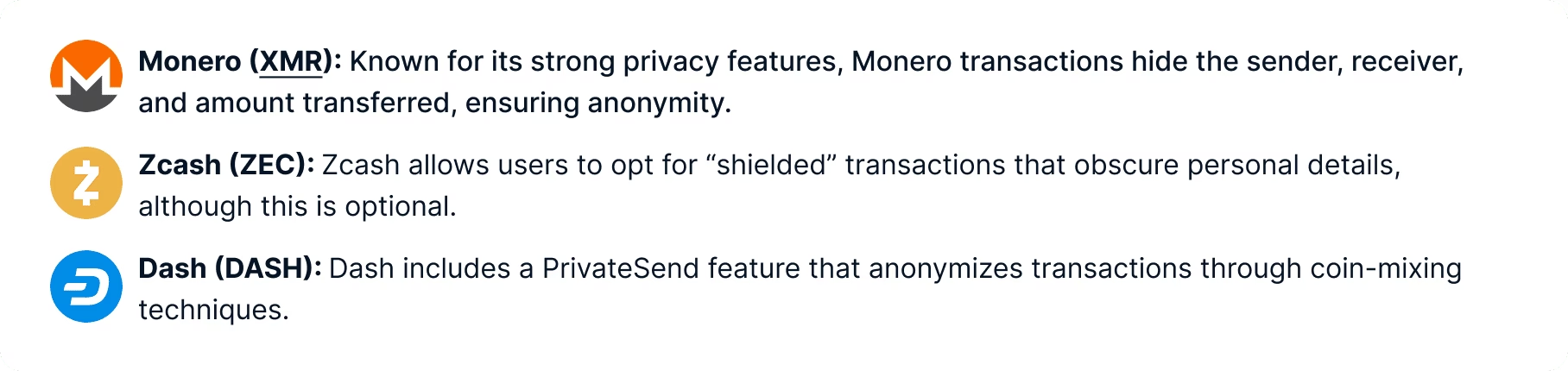
Using Privacy Coins
Privacy-focused cryptocurrencies like Monero, Zcash, and Dash use advanced cryptographic techniques to obscure transaction details, making it harder for third parties to trace the movement of funds.
Of course, they won’t help if you’re using a casino that requires ID verification before you can withdraw. However, using them does provide an extra layer of security, addressing some KYC and privacy concerns.
VPNs and Anonymizing Tools
Using a virtual private network (VPN) masks your IP address, allowing you to access content, including crypto casinos, via a proxy IP in a different region.
This will allow you to access a casino that is blocked in your country, and it also helps prevent bad actors (including official authorities) from snooping on you. In fact, many people use VPNs like NordVPN, Malwarebytes, and CyberGhost as a matter of course whenever they browse the web.
However, using a VPN doesn’t solve everything. Many online casinos specifically prohibit the use of VPNs. These casinos may terminate your account, freeze your funds, or refuse to payout if they catch you using one.
And of course, using a VPN won’t help if you have to provide official documentation proving your identity and address. Additionally, in some countries, just using a VPN is illegal.
Tips for Choosing a Good Privacy-Friendly Crypto Casino
- Research, research, and then research some more:
Because KYC-free crypto casinos will either have a license of dubious value (e.g. Anjouan) or no license at all, you’ll need to thoroughly check a platform’s reputation. Don’t just take the first reviews you find at face value. - Provably Fair Games:
The best crypto casinos will offer provably fair games. These are blockchain-based games that allow you to personally verify the fairness of game outcomes. - Platform Transparency:
Good crypto casinos will be as transparent as possible in their operations. They will provide readily available terms and conditions, banking information, clear KYC and privacy policies, and full information about the operating company. If you have trouble finding any of these things, it’s a red flag.

Stay Anon:
Your Privacy Fortress for
Crypto Gambling


Fortify Your Privacy: Building Layers of Protection

Using Privacy Coins
Use Monero, Zcash, or Dash to keep your transactions private and untraceable.
VPNs & Masking Tools
VPNs hide your IP and location—essential for avoiding geo-blocks. Just make sure your casino allows it.
User Privacy
Lock down your identity with tools that block tracking, leaks, and surveillance.
KYC-Free Platforms
Pick a KYC-free casino with transparent rules, fair games, and real player feedback.
Weighing the Risks and Benefits of KYC-Free Casinos
The KYC and privacy conflict is always going to be a balancing act.
On the one hand, genuinely KYC-free casinos are convenient and allow you to gamble completely anonymously. On the other, using them is inherently risky because you won’t be protected by the safeguards found at strictly regulated platforms.
Below, we’ll run through the main risks and benefits of KYC-free casinos.
Security and Business Sustainability
The absence of KYC procedures can make crypto casinos more vulnerable to fraud, cheating, and other malicious behavior. Needless to say, this can be damaging to any business. The inevitable result is that KYC-free casinos are more likely to disappear into the night, leaving players out of pocket.
Game Fairness and Transparency
Although provably fair games can help assure the fairness of games at KYC-free casinos, there is still a risk factor.
In highly regulated gambling jurisdictions, like the UK or Malta, casino operators are required to undergo regular audits by accredited third-party test labs. These ensure that the RTP (Return to Player) rate of games is accurate and the RNGs (Random Number Generators) used are genuinely random.
Because they are licensed in lax jurisdictions or not licensed at all, KYC-free crypto casinos are not subject to the same scrutiny.
Jurisdictional Risks
As already touched upon, in some countries, using KYC-free or unlicensed gambling platforms is illegal. Using a VPN or other tools to circumvent restrictions could land you in legal hot water too. And, even if you avoid these issues, if you’re gambling illegally, who are you going to complain to if a casino just refuses to pay your winnings?
Weighing the Tradeoffs of KYC-Free Casinos
Benefits of KYC-Free Casinos
Benefits
- ⚡ Speed: Skip the paperwork and start playing instantly.
- 🕵️ Anonymity: No need to reveal personal identity or financial info.
- 🔐 Privacy: No documents = no risk of leaks or data misuse.
Risks of KYC-Free Casinos
Risks
- 🔓 Security Gaps: risk of scams, fraud, and unstable platforms.
- 🌍 Legal Grey Areas: Some jurisdictions may flag or restrict access.
The Future of KYC and Privacy in Crypto Casinos
KYC and privacy at crypto casinos can’t be viewed in isolation. The push for more intrusive KYC in online gambling is part of a wider effort by governments to erode personal freedoms and privacy. But, as mentioned at the very start of this article, there’s a paradox developing. So, before we conclude, let’s just take a close look at what we can expect in the future.
Trends in KYC Regulations
Authoritarians, including many politicians and lawmakers, hate all things crypto. This has become absolutely apparent over the past decade and is perfectly logical. The use of cryptocurrencies, and decentralization in general, gives more power to individuals and takes power away from centralized authorities.
This set the stage for a conflict. Indeed, it’s a conflict we’ve seen playing out for years — exemplified by the United States SEC (Securities and Exchange Commission) trying to take down crypto project after crypto project.
However, while in the broader crypto space it’s relatively easy to fight back against draconian moves from authorities, in the online gambling space things are different. Because when it comes to online casinos, authorities can invoke the ‘colorful’ past of the gambling industry.
Specifically, they can play on the emotive issue of problem gambling and high-profile money laundering cases. These justifications will probably enable them to continue to tighten KYC and privacy rules in regulated markets.
Decentralized ID Solutions and Privacy-Enhanced KYC
However, blockchain technology also offers potential solutions for streamlining KYC processes. Specifically, decentralized identity (DID) systems and zero-knowledge proofs (ZKP) allow identity verification without revealing sensitive personal data to individual casinos.
In theory, crypto casinos could adopt these systems to allow players to prove they meet regulatory requirements without compromising anonymity.
However, although such systems would reduce risks associated with handing over personal data to casinos (like hacks and data theft), they would not necessarily hide your online actions from the authorities. After all, operators are required to cooperate with law enforcement and regulators to identify individuals and stop them using platforms for illicit purposes like money laundering.
The KYC Tug-of-War
Increasing Regulation
Decentralized Privacy
Conclusion
KYC and privacy are, at the very fundamental level, incompatible with each other.
The former requires, by its very nature, the provision of sensitive personal information to another party (the casino operator and authorities, or just the authorities in the case of DID). Even if new tech can improve convenience, this ultimate truth remains.
Hence, the only way to gamble online in a truly anonymous way is to use a combination of trully KYC-free platforms (ideally fully decentralized), VPNs, and privacy coins. However, for most players, the risks and hassle of doing so aren’t worth it.
For most people, the key will be striking an acceptablebalance between KYC and privacy. If you want the highest level of consumer protection, you should play at an online casino with a gold-standard license (UKGC, MGA, etc.). However that likely means you won’t be able to use crypto.
A realistic trade-off is to select a Curaçao or Anjouan licensed crypto casino. This means you’ll be able to open an account and start playing with no KYC, but may still have to verify your identity before cashing out.
Whichever approach you choose, remember to do the following:
- Research the reputation of the crypto casino
- Check for transparency regarding payments, terms and conditions, and company details
- Look for features like provably fair games
- Consider using privacy coins if supported
- Use a VPN if allowed
- Make sure any site you submit information to is secure and has a valid security certificate
We hope you’ve found this original CoinBets guide helpful, and if you’ve got any thoughts or experiences regarding KYC and privacy in crypto casinos, we’d love to hear from you below.
Join The Conversation
No comments yet. Be the first to comment!


Comments (0)
Share