





 Continue with Apple
 Continue with Google

Betting on Blockchain-Based Prediction Markets: The Intersection of Crypto Casinos and Forecasting Platforms
The emergence of blockchain technology is rapidly transforming many industries, with its decentralized infrastructure enabling innovative alternatives to traditional systems. One of the sectors where blockchain is having a very significant impact is online gambling, with prediction markets and crypto casinos growing in popularity.
Blockchain-based prediction markets are decentralized platforms enabling users to bet on the outcome of real-world events. These include sports, politics, economics, entertainment, and even weather events - pretty much anything. By leveraging blockchain’s immutability and transparency, this decentralized form of betting offers many advantages over traditional centralized betting.
Decentralized prediction markets have found a natural home at crypto casinos, which already embrace elements of blockchain technology - allowing players to use cryptocurrencies and offering provably fair games. Indeed, unlike the traditional sportsbooks offered at legacy online casinos, blockchain-based prediction markets can be run autonomously, using smart contracts to facilitate every process from placing bets to paying out winnings.
In this original CoinBets.com guide, we’ll take a close look at how blockchain-based prediction markets work, how the technology is reshaping the crypto gambling landscape, and what we can expect to see moving forward.
How Prediction Markets Work
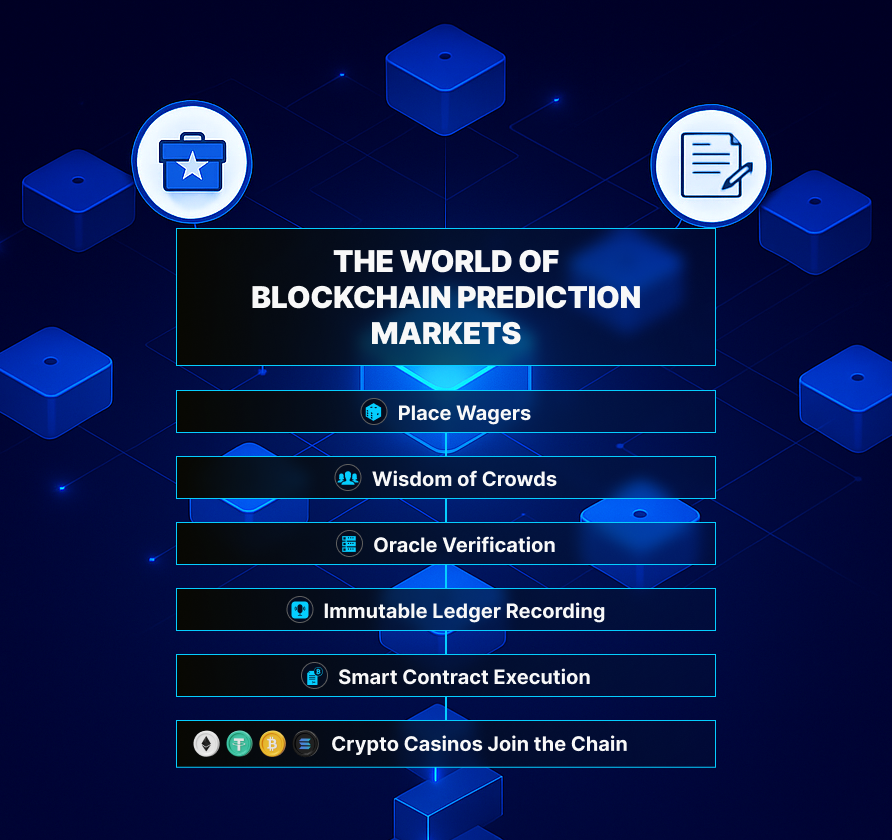
Though it may seem complicated at first glance, the concept behind prediction markets is quite simple. Users place bets on future events, and then that collective knowledge (or “wisdom of crowds”) is transformed into a tradable commodity via blockchain and smart contracts. This system allows users to speculate on virtually any real-world events, ranging from sports and politics to economics, weather, and celebrities. Whatever that subject is, the underlying mechanism is the same and straightforward: people bet on what they think the likelihood of a specific event happening is, and those predictions are recorded onto a blockchain-based decentralized ledger - guaranteeing transparency and security.
Of course, to facilitate this, blockchain-based prediction markets need reliable data sources. These are called “oracles” and feed real-world outcomes (like sports scores, election results, or stock prices) into the blockchain. Trusted oracles are critical because the blockchain itself can’t access data from beyond its own network. Following the confirmation of a specific real-world outcome, smart contracts (self-executing programs stored on the blockchain) automatically work out and distribute payouts to the winning bettors.
The entire process is seamless and removes the need for any central authority or middleman to manage odds or resolve outcomes. It is, in effect, peer-to-peer, with individual bettors as the only people involved in the process.
The intersection of Prediction Markets and Crypto Casinos
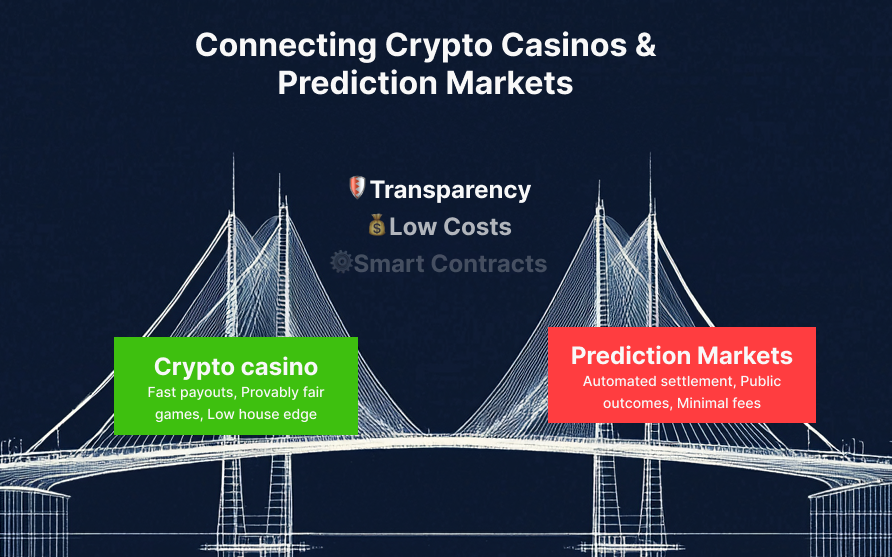
As things stand, crypto casinos and peer-to-peer prediction markets may seem quite separate. After all, most crypto casinos are still relatively centralized platforms run by an operating company. However, the integration of the two is progressing rapidly. While the focus of most crypto casinos is still very much slots, table, and card games, blockchain-based prediction markets provide an entirely new dimension of engagement - adding much more variety than traditional sports betting. And, because they don't require extra staff or resources to manage them, blockchain-based prediction markets can be easily integrated into existing crypto casino businesses.
Of course, standalone prediction market platforms, like Polymarket and Augur, are still dominant in the space - having become well-known in the cryptocurrency community. These platforms allow people to bet on virtually anything using a wide range of cryptos. Illustrating just how much scope these platforms have, at the time of writing, these were some of the most popular markets at Polymarket:
- Presidential Election Winner 2024
- Popular Vote Winner 2024
- Balance of Power: 2024 Election
- Who will HBO doc identify as Satoshi?
- Tipping Point State in 2024 Election
- Will Trump win Florida by 8+ points?
- Israeli military response against Iran by Friday?
- Milton landfall at what category?
- Democratic VP nominee on election day?
- Sao Paulo mayoral election 2024
- Ballon d’Or Winner
- Fed Interest Rates: November 2024
- Super Bowl Champion 2025
- Premier League Winner
- Highest-grossing movie in 2024
- Will Ukraine join NATO in 2024?
- First FTX bankruptcy payout?
- Elon Musk # of tweets Oct 4-11?
- What price will Bitcoin hit in October?
As you can see, the scope of betting goes far beyond the remit of traditional sportsbooks, making prediction betting appealing to a much broader market. Importantly, because these prediction markets are blockchain-based, everyone involved can have faith their bets are transparent and immutable. This contrasts greatly with traditional sportsbooks and betting platforms, which have a high degree of opacity and are often accused of manipulating both odds and payouts.
Advantages of Blockchain Technology in Prediction Markets
So, now we’ve seen how blockchain-based prediction markets work, let’s just recap their main advantages over traditional centralized betting platforms.
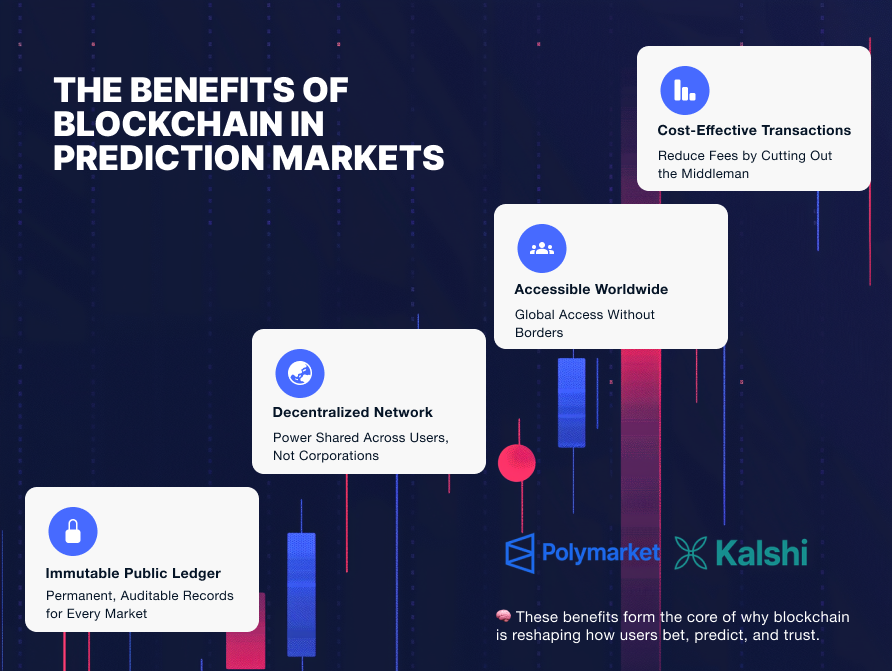
1. Transparency and Trust
Perhaps the most significant advantage of using blockchain in prediction markets is the transparency it provides. Because each bet is recorded on a decentralized public ledger, that can’t be altered and can be checked by anyone, all participants can trust transactions and outcomes. Conversely, traditional online betting platforms operate behind closed doors, with bettors having to trust an operating company (that is driven by profit) to resolve bets fairly.
2. Decentralization
Because they operate on geographically distributed peer-to-peer networks, blockchain-based prediction markets are not controlled by any central authority. This means no single entity controls the platform or its outcomes. Instead, decentralized prediction markets rely on consensus and oracles to verify outcomes. This massively enhances the integrity and security of the entire system.
3. Global Accessibility
The decentralized nature of blockchain-based prediction market platforms also has another huge advantage - no one can stop people from accessing them. In the traditional online gambling space, users often face complicated regulatory frameworks and geographical restrictions. But, because decentralized networks aren’t based in any one place, they can’t be controlled by local laws, and because bettors use cryptocurrencies, they aren’t hindered by banking limitations.
4. Lower Fees
Additionally, because blockchain prediction markets use cryptocurrencies and smart contracts, transaction fees are generally very low. On the other hand, traditional betting platforms, using fiat currencies, are forced to rely on third-party payment processors, banks, and other intermediaries. These often charge high fees which are often at least partially passed on to the user.
Real-World Applications: What Can You Bet On?
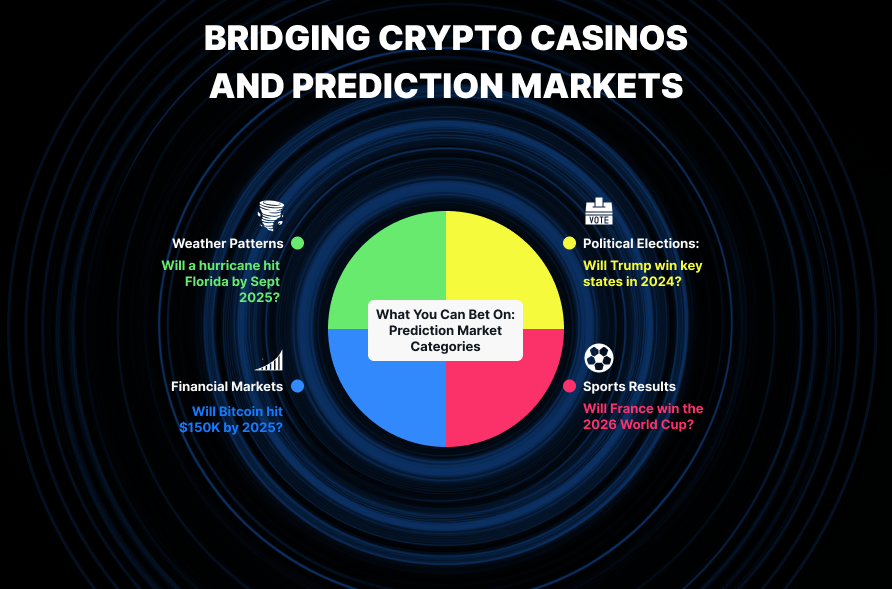
As we’ve already seen, the scope for prediction market bets is huge and always expanding. However, some categories tend to dominate the space. Below, we’ll run through a few.
Political Elections
Do you ever start chatting about politics at work, or when you’re out having drinks with friends? Of course, you do. Everyone does. It’s one of those things that everyone has an opinion on and people get very passionate about. So, it’s not surprising that political election results are one of the most popular types of bets on prediction market platforms. This was perfectly illustrated by various bets about the 2024 US elections dominating Polymarket at the time of writing this article.
Sports Results
The sheer size of the traditional sports betting industry speaks to how popular wagering on sports results is. Whether it's football, basketball, tennis, or Formula 1, millions of people bet on sports every day. However, blockchain-based prediction markets allow for a new level of transparency and trust, as well as a much wider range of markets.
Financial Markets
The traditional global financial markets offer plenty of betting opportunities, from whether a company’s stock price will rise or fall by a certain percentage by a given date to whether a particular central bank will raise interest rates. Of course, the highly volatile cryptocurrency markets provide many exciting possibilities too (if you want to learn more about mitigating the risks of cryptocurrency fluctuations when gambling, check out the exclusive CoinBets.com guide).
Weather Patterns and Climate Change
While writing this guide, hurricane Milton was approaching Florida and rapidly strengthening - surpassing all of the forecasts and causing millions to flee. But, as awful as that is for those caught in the storm’s path, it's created a lively prediction market, with people betting on what strength the hurricane will be when it makes landfall. Indeed, in today’s unstable environment, weather events are an increasingly popular thing to bet on.
How Blockchain Prediction Markets Differ from Traditional Betting
Right, we’ve looked at how blockchain-based prediction markets work and the kind of events you can bet on, so now let's recap how they differ from conventional betting platforms.
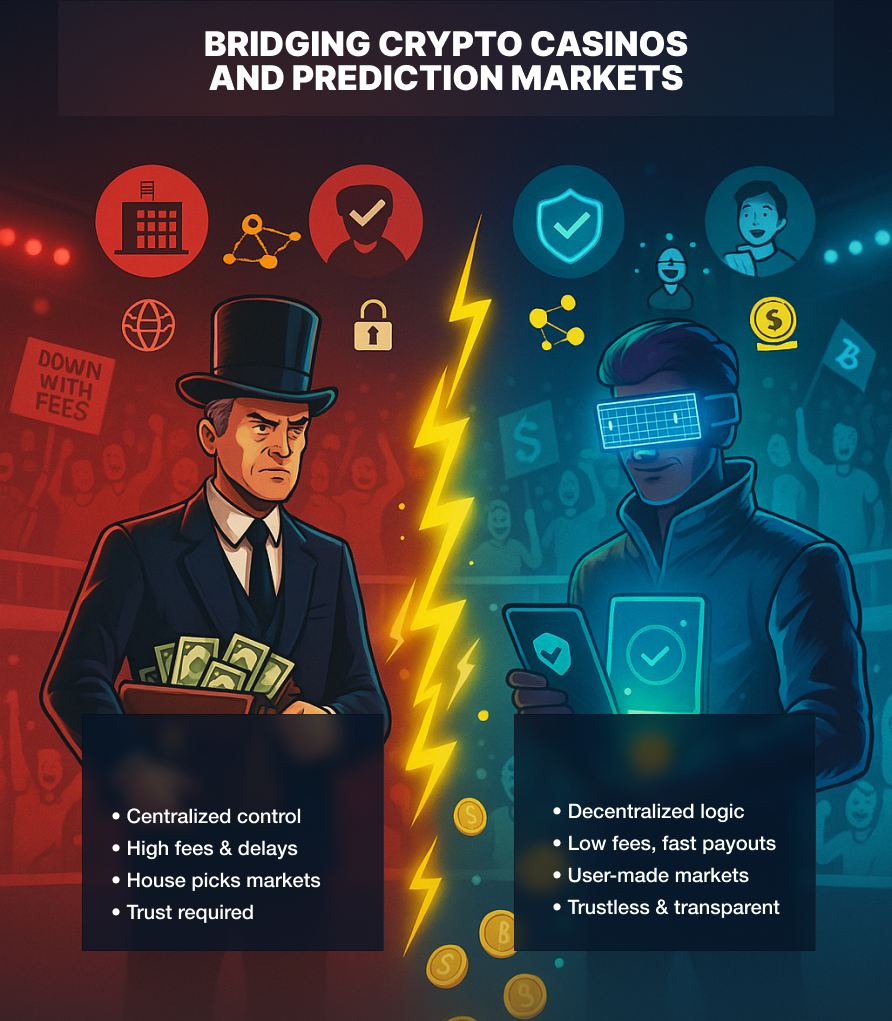
Decentralized vs. Centralized
A traditional sportsbook will be centralized - operated by a company, based in a physical location, with employees. The company will have many operational costs, including salaries, rent, data feed suppliers, payment processor fees, and even the electricity bill. Yet, the overall goal of the expensive-to-run company will be to make as big a profit as possible. So, the fact that bettors have to trust the operator to set odds, manage bets, and distribute winnings fairly, is quite an ask.
On the other hand, a blockchain-based prediction market platform operates in a decentralized manner. It has no operating company, so there aren’t all the expensive operational costs to cover. And, rather than outcomes being determined by a single controlling entity (the bookmaker), they are determined based on consensus mechanisms and data provided by trusted oracles. This peer-to-peer approach massively reduces the potential for manipulation, improves efficiency, and ensures everyone is treated fairly.
Verifiability
Focusing on that trust issue - the fact is that with a traditional betting platform, bettors have to completely trust the house to settle bets correctly and fairly. Even if the betting operator is licensed by a reputable regulator, like the UK Gambling Commission (UKGC) or Malta Gaming Authority (MGA), the average user simply has no way of knowing if manipulation is taking place or not. And, even if a customer does suspect foul play and raises a dispute with the relevant authorities, the process will be very time-consuming and stressful.
Conversely, users of blockchain-based prediction market platforms can audit the results on the blockchain themselves. And, in reality, the resources a bad actor would need in order to even try and manipulate most blockchains would be so prohibitive that it's unlikely to happen. Put simply, blockchain prediction markets are “trustless” - meaning there’s no need to put your trust in anyone.
Market Creation
One of the most engaging features of blockchain-based prediction markets is the ability for users to create their own markets. While not entirely unheard of, this kind of functionality is extremely rare on traditional betting platforms - with most markets created and controlled by the platform operator. However, users of decentralized platforms like Augur can easily propose markets for any real-world event - as long as it complies with the platform’s rules.
Cryptocurrency Payouts
Finally, because blockchain-based prediction markets use cryptocurrencies for betting and payouts, transactions are faster, cheaper, and more efficient than those at traditional betting platforms. Additionally, using crypto removes the increasingly common problem of banks and card issuers blocking gambling transactions.
Popular Blockchain-Based Prediction Platforms
As Web3 matures, many interesting blockchain-based prediction platforms are being launched, but let’s take a moment to look at some of the trailblazers in the sector.
- Add Logo image Polymarket - Developed by Shayne Coplan and founded in 2020, Polymarket lets users wager on a massive range of markets using the USDC stablecoin. Although the platform is managed by a company (Adventure One QSS Inc.), the markets are based on the Polygon network and operationally decentralized. The platform has a very user-friendly interface and is particularly known for its extensive political and financial markets.
- Add Logo image Augur - One of the first successful decentralized prediction markets, crowdfunding for the project started in mid-2015 and the Ethereum-based project officially launched in mid-2018. After attracting controversy when users created “death pools”, or assassination markets on famous people, the Augur Project has since matured and remains one of the leading freeware prediction market platforms.
- Add Logo image Gnosis - This project began life in 2015 as a decentralized prediction market on the Ethereum blockchain (via the now-discontinued Gnosis Olympia dApp). In late 2020, the GnosisDAO (Decentralized Autonomous Organization) was established, and today several prediction markets are available in third-party dApps like Azuro, Omen, and Reality Card, which are built on the Gnosis Chain. Gnosis has also developed Conditional Tokens, which is a new digital asset class designed specifically to facilitate highly liquid prediction markets.
The Future of Blockchain Prediction Markets and Crypto Casinos
Fueled by technological innovation and a growing desire for digital freedom, there’s a clear global trend toward decentralization, and nowhere is that more evident than in the online gambling industry. Obviously, there are far too many factors at play to cover in this article - and we’ll likely see several curveballs that result in completely unpredictable developments. But, there are a couple of things we should definitely be looking out for.
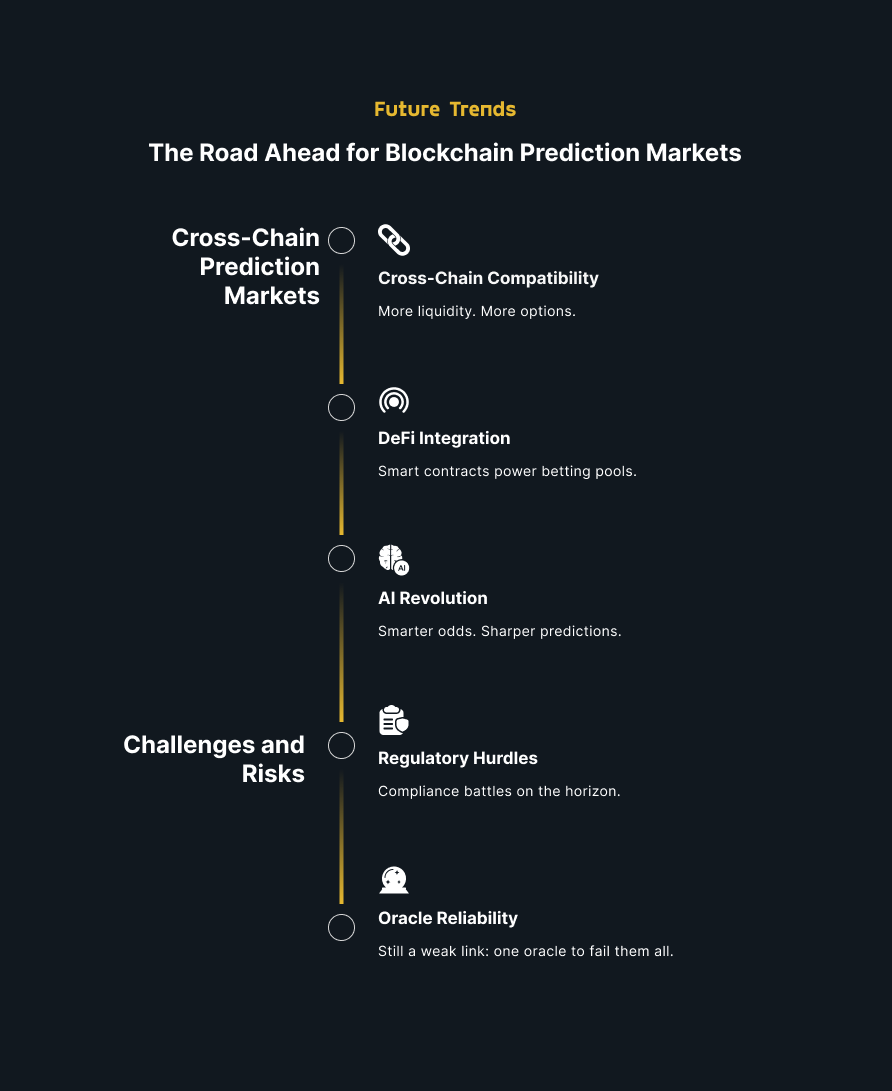
Firstly, cross-chain prediction markets, like Grail Market, which enable users to bet across different blockchain networks, will significantly improve liquidity and market variety. Indeed, the proliferation of cross-chain compatibility is something set to boost blockchain and crypto adoption across all sectors in the next few years. In a similar vein, the integration of decentralized finance (DeFi) into prediction markets will open the door to much more sophisticated (or maybe, “dangerously complicated?”) betting mechanisms - for example, allowing the lending and borrowing of funds to participate in prediction markets.
And, of course, there’s the whole AI revolution to factor in. With the ability to analyze rapidly increasing amounts of data in split seconds, artificial intelligence and machine learning will play a big role in enhancing prediction market outcomes and improving the accuracy of forecasts. So, as AI tech becomes more accessible to everyone, it will likely create something of a paradox - simultaneously improving the accuracy of both those creating prediction markets and those betting on them. Hopefully, it won’t rip a hole in the space-time continuum though.
Potential Risks and Challenges
Finally, we can’t discuss anything blockchain or crypto-related without touching on some of the very real potential risks and challenges ahead. Chiefly, these concern regulatory and legal hurdles. Unsurprisingly, many governments and regulatory authorities hate decentralization because it takes away their power to control. For more than a decade, we’ve seen politicians and bodies like the SEC (US Securities and Exchange Commission) trying to fight the crypto revolution. And, despite it being obvious they are on the wrong side of history, we shouldn’t expect them to quit their shenanigans just yet. For example, we’ll probably see a crusade launched against peer-to-peer betting, with old politicians claiming it “finances terrorism, destroys the climate, and kills puppies.”
Aside from the regulatory challenges blockchain-based peer-to-peer betting is likely to face over the coming years, there is one glaring technical concern. That is oracles. For blockchain prediction markets to work properly, oracles must be able to be relied on and trusted - they are a concerning single point of failure. A blockchain and the smart contracts running on it can be watertight, but if the data being provided by the oracles themselves is manipulated or corrupted, then the entire system is compromised. This is why it is essential for prediction market platforms to manage oracles correctly, building in extra redundancy and checks.
Potential Risks and How to Mitigate Them
While they offer plenty of advantages for esports bettors, using cryptocurrencies does carry a level of risk. Here are the main issues to be aware of:
- Volatility of Cryptocurrencies: As you’ve probably noticed, even the most established cryptos like Bitcoin can fluctuate wildly in price. This gives the potential for the value of your winnings to change between the time you place a bet and the time you withdraw
- Regulatory Considerations: In some countries, the laws applying to cryptocurrencies and their usage are still unclear (or non-existent). Always check the legalities and regulations in your region before you engage in crypto esports betting.
To learn more about the potential risks of using crypto, check out the CoinBets.com article Cryptocurrency Fluctuations and Gambling: Strategies to Mitigate Risk.
Conclusion
Blockchain-based prediction markets are finally allowing real peer-to-peer betting on a global scale. In the process, they are making it possible to bet on virtually any real-world event, from sports and politics to financial markets and climate events. In turn, this is making betting more appealing to more people than ever before. And, in theory, at least, it should make betting safer and more secure.
For bettors, this is all very positive. But, the writing could be on the wall for some betting operators. While those online casino operators who embrace the change and integrate truly decentralized prediction markets into their existing platforms will likely thrive, those who don’t will be consigning themselves to the dustbin of history. Unfortunately, operators in highly regulated markets probably won’t be able to integrate truly peer-to-peer betting for the foreseeable future, so the future probably belongs to the dynamic offshore crypto casinos on the one hand, and completely decentralized platforms operated by DAOs on the other.
But, however the cookie crumbles, decentralized prediction markets are opening up undreamt of betting possibilities, and are definitely here to stay. If you’ve got any interesting experiences with blockchain prediction markets, or ideas about where things are heading, we’d love to hear from you below.