





 Continue with Apple
 Continue with Google

Behind the Scenes: How Crypto Casinos Work as a Business
If you’re reading this, you’re probably already fairly familiar with the public face of crypto casinos - but, have you ever wondered about what goes on behind the scenes? In this original CoinBets guide, I’ll take you on a guided tour of the ins and outs of the crypto casino business. We’ll look at everything from revenue streams and casino marketing to the organizational structure and operational side of running a crypto casino business.
Revenue Streams: How Crypto Casinos Make Money
So, first things first, let’s take a look at the business model of a typical crypto casino - how they generate revenue and make a profit.
House Edge: Why “The House Always Wins”
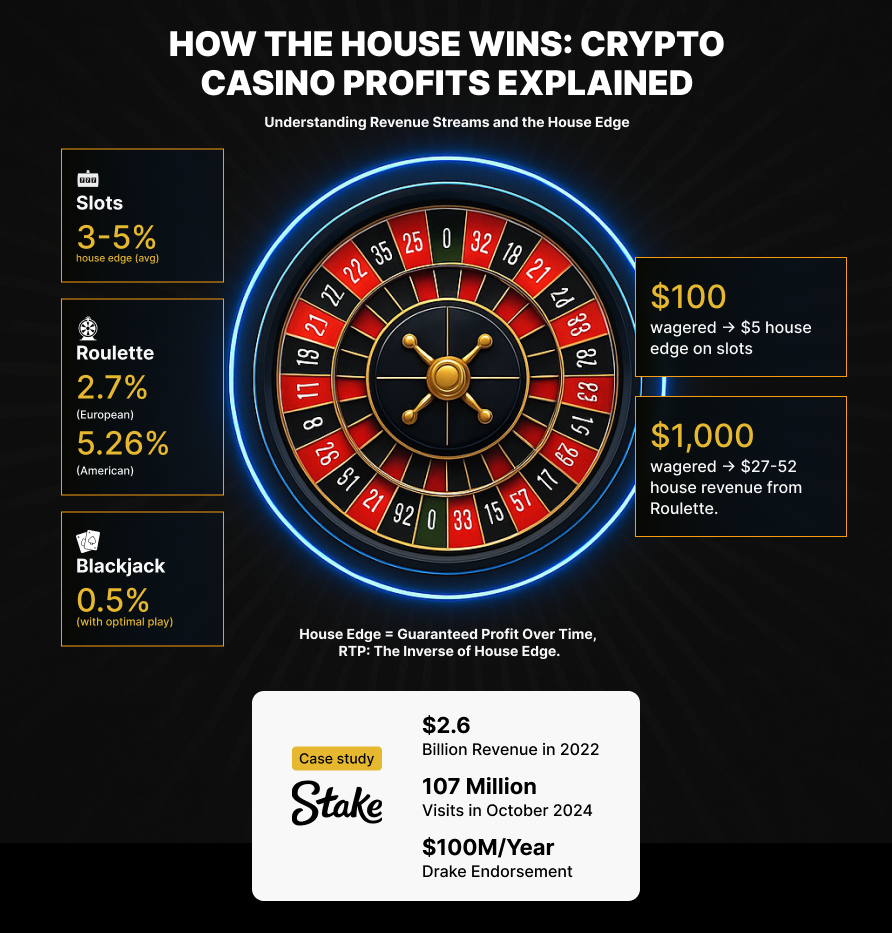
The term “the house always wins” is frequently used when discussing casinos. This is because, fundamentally, all casinos turn a profit thanks to the mathematical advantage known as the house edge. This is the theoretical percentage of the money players wager the casino can expect to keep. Different games have different house edge rates, with some being more lucrative for casinos than others.
For example, online slots typically have a house edge of 3-5%, while blackjack margins can be as low as 0.5%. This means that, for every $100 spent on an average slot, the casino can expect to pocket between $3 and $5, and for every $100 spent on blackjack, the casino might only take $0.50. The inverse of the house edge is the Return to Player (RTP), which is also expressed as a percentage. This expresses the theoretical percentage of money wagered that players can expect to get back. So, if the house edge is 5%, then the RTP is 95%.
Of course, it’s important to appreciate that house edge and RTP are calculated over a vast number of game rounds - so it’s still perfectly possible for individuals to walk away with big wins, and for casinos to lose money over short periods. It just means that, in the long term, the house should always win. If you’re interested in reading more about this, we’ve got an exclusive CoinBets guide to understanding RTP.
Notably, one of the problems with traditional online casino games is that players have to trust the operators and game providers regarding the house edge/RTP. However, at crypto casinos, provably fair blockchain-based games offer complete transparency. So, even though the RTP of these games is customizable by the casino operator, players can personally verify that the rate stated is accurate (guess what? Yep, we’ve also got an original CoinBets guide to provably fair games too).
Case Study: Stake
Now, those house edge percentages may sound pretty low, but you have to put things in perspective. Some online casinos count their customer base in the millions. And, while the exact number of customers and revenue is understandably hard to ascertain for offshore crypto casinos, according to Semrush, Stake.com, one of the world’s most popular crypto casinos, received over 107 million visits in October 2024 alone. If even just a small fraction of those are wagering players, it's easy to see how making even a few percent house edge can be very lucrative.
Indeed, crypto news site Blockworks quoted a Financial Times report claiming that Stake made $2.6 billion in gaming revenue in 2022. Of course, that was still during the COVID-19 pandemic digital boom, but even so, considering the continued growth of crypto gambling, it’s safe to assume that by 2025 that figure will be even higher. I guess that’s how Stake could afford to pay Canadian rapper Drake $100 million per year to endorse the crypto casino! But, we’ll cover marketing and partnerships later.
Transaction Fees and Crypto Payment Processing
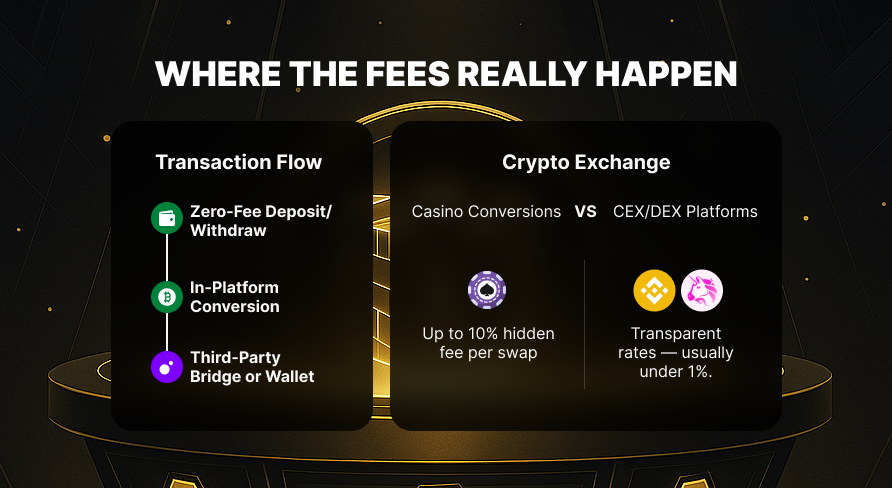
For many years, it was normal for online casinos to charge fees for deposits and withdrawals. These fees tended to be very small, but again, if a site is processing thousands of transactions per day, even a percent or two here and there can add up to significant revenue. Thankfully, most online casinos, and virtually all crypto casinos, now offer free deposits and withdrawals - indeed, players have come to expect it, and it would be difficult for a casino to keep players if they did charge fees these days.
However, crypto casinos do generate additional revenue from fees for conversions between cryptocurrencies. For example, some crypto casinos allow users to buy cryptocurrencies directly on-site via integrations with third-party providers like Moonpay. This is very convenient for players who are new to the crypto space, but transaction fees are considerably higher than using one of the major centralized crypto exchanges (CEX) like Binance or Coinbase or a decentralized exchange (DEX) like Uniswap. Illustrating this, at the time of writing, if I wanted to buy Litecoin using Euros directly on-site, I would be paying anywhere from a 1.75% fee for using Visa to a whopping 10% for Paysafecard.
Netting the High Rollers: VIP and Loyalty Programs
Traditionally, most online casinos have generated a large proportion of their revenues from a relatively small number of wealthy, high-spending players. Because of this, casino operators poured resources into attracting these high rollers, and crucially, keeping them loyal. For example, during my time working in the iGaming industry, I’ve seen casino operators give their most valuable players gifts like tickets to major sporting events, and even all-expenses-paid luxury holidays.
Now, times have changed, and some regulators, for example, the UK Gambling Commission (UKGC) have banned that kind of thing - but, no doubt it still goes on, most likely “off the books” so to speak. But, offshore crypto casinos, unbound by strict regulation, are still free to do whatever it takes to get the big spenders “through the doors” and keep them happy.
Indeed, VIP and loyalty programs play a very important role in player acquisition and retention at online crypto casinos. Usually, these consist of a tiered structure with players starting at the base and rising through the levels as they earn points. To start with, the rewards are low value, but if players stick around and wager enough, the perks can get serious. For example, top-tier members can typically look forward to higher limits, faster withdrawals, significant cash back, and even personal account managers and invites to exclusive events.

Want to find out more? Check out the CoinBets guide to Crypto Casino VIP Programs.
Marketing Strategies: Standing Out in a Hyper-Competitive Space
So, we’ve looked at crypto casino revenue streams, but how exactly do they get customers? I mean, the online gambling space is extremely crowded - and, let’s be honest, most online casinos offer very similar products.
Affiliate Marketing
Affiliate marketing isn’t unique to the online gambling industry. It’s used by virtually every sector, from retail to financial services, and everything in between. However, it is especially important to online casinos and sportsbooks, and even more so to crypto casinos. In part, this is because, due to their offshore/unlicensed nature, crypto casinos are often barred from using other marketing channels in many markets.
Fundamentally, the concept of gambling affiliate marketing is very simple: a casino operator will pay a commission to someone for referring new customers. This leaves the operator free to focus on running the casino and reduces upfront marketing costs. However, affiliate marketing can cause headaches for operators. For example, it can make it difficult to maintain adequate oversight - which often results in highly questionable content and practices (see our guide to spotting fake or dodgy crypto casino reviews). Sprawling affiliate marketing programs, involving thousands of moving parts, can also make it challenging for operators to accurately measure ROI (Return on Investment).
How Gambling Affiliate Programs Work
While crypto gambling affiliate marketing programs vary, as a rule, they tend to offer higher payouts than those in other sectors like retail. This is largely because many programs offer lifetime commission payments (Revenue Share) - this is when the referring affiliate continues to receive a percentage of the revenue a referred player generates for as long as the player stays with the casino in question. Typically, revenue share rates range from 25% to 50% - with specific rates dependent on affiliates reaching certain benchmarks.
Something to note regarding casino affiliate revenue share is “negative carryover.” This applies to situations when a player wins more money than they lose at a casino - thus generating a loss for the casino. In the past, many affiliate programs built this negative carryover into their programs, so, for example, if one month a referred player landed a big win, the affiliate wouldn’t receive any commission payments until the player in question had lost enough to start generating a profit for the casino again. Today, most good casino affiliate programs don’t apply negative carryover.
Types of casino affiliate pay structures:
- Revenue Share - Affiliates receive a certain percentage of revenues generated from a customer they referred, usually for the lifetime of the player.
- CPA (Cost per Acquisition or Action) - A common type in the iGaming world. Affiliates are paid when a visitor does something specific, like making a deposit or wagering a certain amount.
- Hybrid - A combination of CPA and revenue share. For example, the affiliate may receive a set amount when a player opens an account, and then an ongoing percentage of revenue generated from that player.
- Pay Per Lead (PPL) - Under this model, affiliates receive a commission in return for the details of a potential new customer. For example, if the referred visitor creates an account with the casino.
- Pay Per Click (PPC) - The affiliate will receive a set commission for each click through to the casino site. Individual commissions are far, far lower for this model, so it's all about volume. This is the system used by Google Ads (formerly Adwords) and similar programs.
- Pay Per Impression (PPI) - Not as common, this model pays affiliates a fixed amount based on how many times an advert is viewed - typically per 1,000 views.

Case Study: Moonshine Partners
An example of a typical online casino affiliate marketing program is that offered by Moonshine Partners. The program pays affiliates to promote four medium-sized crypto casino brands: Horus Casino, Vegaz Casino, Haz Casino, and Kryptosino.
Casino revenue share commission is paid at the following rates:
- 25% for 1-10 players
- 30% for 11-40 players
- 35% for 41-100 players
- 40% for 101+ players
This affiliate program also offers CPA (Cost per Acquisition) or Hybrid deals with qualifying affiliates - something that’s quite common.
Who are the Affiliates?
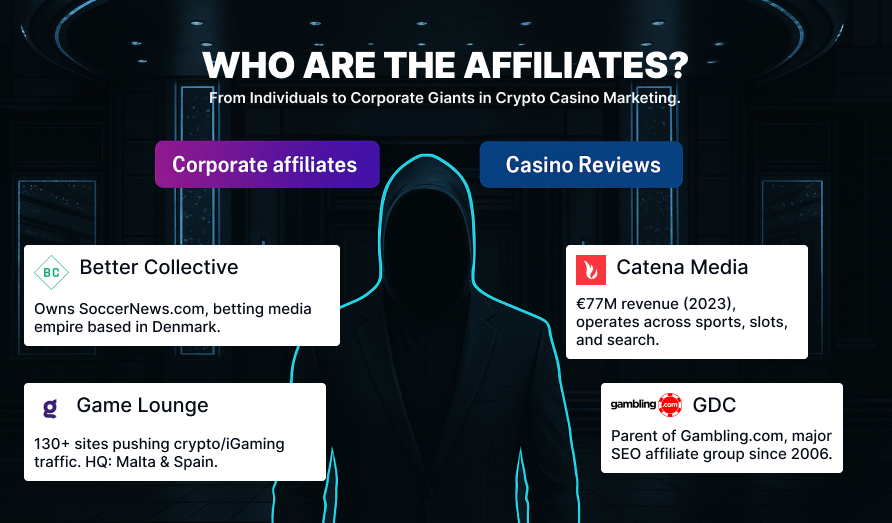
Although it is still possible for individuals to run successful crypto casino affiliate marketing businesses via open-to-all programs like that from Moonshine, the space is now dominated by well-funded corporate operations. These businesses invest millions in teams of search engine optimization (SEO), and content creation specialists.
Illustrating just how big the online gambling affiliate marketing business has become, affiliates and “performance marketing” companies as they like to call themselves, now dominate the many industry conferences, like SiGMA, ICE, and SBC - and they even have their dedicated conference and awards show in the form of iGB Affiliate.
Some major iGaming affiliate marketing companies:
- Catena Media - Founded in 2012, this company generated €77m turnover in 2023 and has offices in Malta and the US.
- Game Lounge - A highly successful affiliate marketing company specializing in iGaming and crypto, based in Malta and Spain. The company has created over 130 websites including Casino Hawks, Norge Kasino, Svea Casino, Casino Italiana, and US Online Casino.
- Better Collective - Focused mainly on betting and branding itself a “sports media group”, this major affiliate marketing company is based in Denmark. It owns brands including Soccer News, Playmaker, Tipsbladet, Daily Faceoff, The Nation Network, HLTV, and many more.
- GDC - This Malta-based iGaming affiliate company was founded in 2006 and attracted investment from the likes of Wells Fargo. It owns one of the world’s most valuable domains, Gambling.com.
Financial Impact of Affiliate Marketing vs In-House Marketing
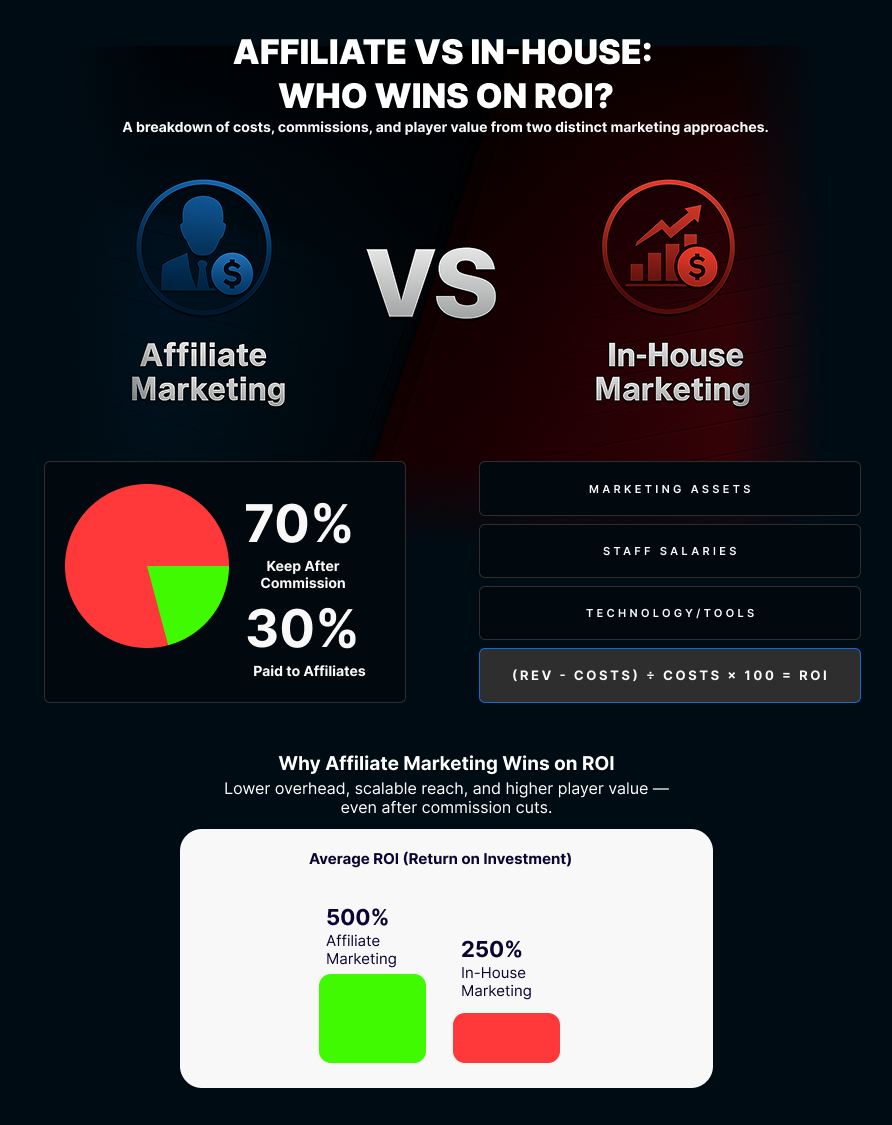
As you can see, affiliate marketing is extremely important for crypto casinos and sportsbooks, but how much does it all cost? I mean, is the ROI worth it, or would it be better for operators to simply bring all marketing in-house? Well, let's break down the numbers.
A crypto casino operator that is running an affiliate marketing program is faced with this equation:
(Affiliate marketing revenue - affiliate marketing costs) ÷ affiliate marketing costs x 100 = ROI
So, if an operator brings in $1,000 from an affiliate marketing program, they first need to deduct the commission they’ve paid to the affiliate, which could be a sizable percentage. So, let's assume that is 30%, or $300. Hence the gross profit is $700. Now we divide the $1,000 by $700, which gives us 1.43. Then we multiply 1.43 by 100 to get an ROI of 143%. That’s a pretty respectable rate.
But, the key question here is how much revenue are your affiliates going to bring in. Well, that is going to depend on far too many factors to go through here. Let's assume the average ROI across all affiliates marketing your casino is the aforementioned 143%. A 143% ROI on $5 million is great, but a 143% ROI on $5,000 isn’t exactly going to keep your lovely new crypto casino in business for long!
This is why it is so important for affiliate program operators to accurately estimate the “Customer Lifetime Value” (LTV) of the players a specific affiliate can effectively target. Simply put, some crypto casino customers are going to spend far more during their time at the casino than others. Hence, affiliates who have proven they can consistently bring in players with higher LTVs can usually negotiate much more generous deals with casino affiliate program operators. Many factors affect LTV, but some of the key ones are geographical location, gender, and age.
Of course, there will also be additional costs for the casino operator. For example, they will need to provide their affiliates with various marketing assets and have staff to oversee the program (or pay to outsource the management of the affiliate program). How much an operator chooses to spend on this will vary - some run very basic affiliate programs, while others provide their affiliate partners with extensive resources and support.
The Challenges of In-House iGaming Marketing
Now, let’s compare that to the realities of running an in-house marketing. Obviously, casino operators don’t exactly make a habit of publicly sharing how much they have spent on marketing campaigns, but I can use a couple of examples from personal experience.
First up, I’ve worked as a content writer directly for a medium-sized online casino operator. In fact, I was their only English content writer. This meant that I was responsible for pretty much any English-language content - from on-site landing pages and terms and conditions to marketing emails, blog posts, and advertorials for industry magazines and sites. Needless to say, there was only so much time I could dedicate to marketing content! And my SEO team? Well, that was one guy too. A very capable guy, but still just one person.
Compare this to when I worked for a major affiliate marketing company. They had offices in several countries, and a global network of people working remotely, plus access to many freelancers. They had dozens of content writers, editors, graphic designers, UX specialists, and SEO experts. All of these people were focused solely on building and optimizing websites to market online casinos and sports betting sites. The efficiency of scale and the expertise available in this single company were incredible.
There’s simply no way that the casino operator I worked at could hope to match the marketing effectiveness of the dedicated performance marketing company. And this is precisely why, despite undertaking some in-house marketing, the casino operator I am talking about did launch its own affiliate program. Simply put, given the competitiveness of the online gambling market, the resources and expertise needed to successfully market a crypto casino are so great, that it doesn’t make financial or logistical sense for most online casino operators to do the majority of marketing in-house.
SEO and Content Marketing
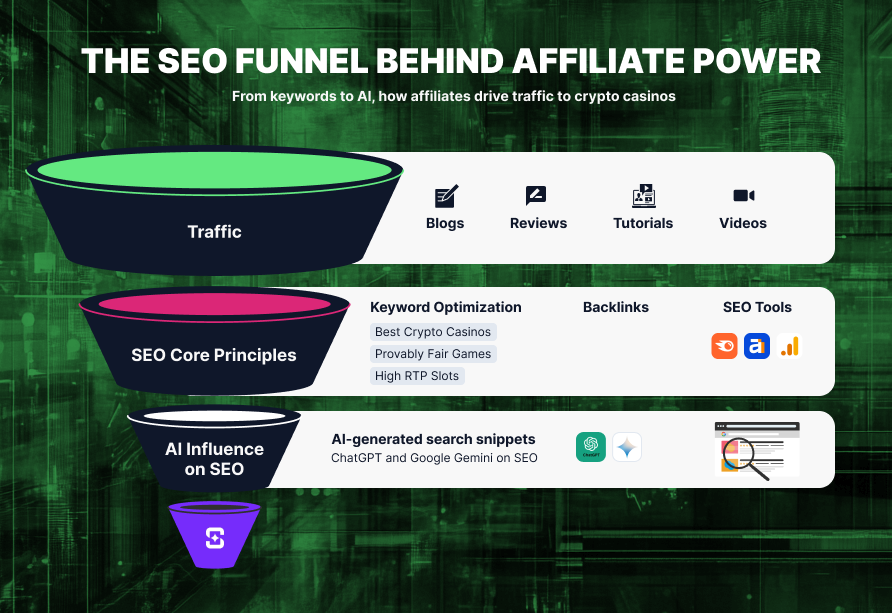
Okay, so, how do these affiliates actually market crypto casinos? Well, it’s all about content, with a heavy dose of SEO (Search Engine Optimization). Basically, all of these affiliates, whether one-man operations or huge multinationals, pump out boatloads of content about all things related to crypto gambling. From reviews, guides, and tutorials, to news and editorial commentary, a vast amount of content is published daily in both text and video form. But, it is all created and published for one ultimate reason - to attract traffic that can then be referred to casinos and sportsbooks - thus earning commissions.
Of course, there’s nothing inherently cynical about this. The business model behind newspapers, magazines, radio stations, and TV channels is based on creating content to attract readers and viewers so that the publisher or broadcaster can make money from advertising. Today’s online affiliate marketing is essentially the same, just more high-tech and targeted.
Key aspects of SEO and content marketing
The field of search engine optimization is vast and constantly evolving - so it’s not possible to go into great detail here, but there are a couple of core principles that everyone involved in content marketing needs to appreciate.
SEO and Content Marketing
For a piece of content to rank highly on Google, it must contain the keywords and phrases people are actually searching for. Fundamentally, keywords are how search engines match user intent with results. For example, if lots of people are always searching for “best crypto casinos” or “best provably fair games” then you’re going to want to target these keywords.
But, it’s not that simple anymore. The sheer volume of content and ever-increasing sophistication of Google’s algorithms means getting a piece of content found, let alone getting it on the first page of Google is something akin to alchemy. These days, Google analyses so much more than just the number of times a keyword or phrase appears on a page. Content structure, context, and much more also feed into determining the visibility of a page.
Backlinks
Although some would argue they aren’t quite as important as they once were, links from credible pages on other websites are still a vital factor in SEO. These effectively act like citations or references in an essay or paper - signaling to Google that other people find your content to be credible and improving your domain authority. Of course, these links are more valuable if they are coming from sites that are themselves considered authoritative.
SEO Tools
To help optimize content, SEO teams use a variety of specialist research and content creation tools - some of the most popular being:
- Semrush
- Ahrefs
- Google Analytics
- Answer the Public
- Surfer
However, as someone who’s been working as a professional writer in the iGaming industry for almost a decade, I can say that SEO is as much of an art as it is a science. I’ve worked with SEO professionals from some of the world’s most successful affiliate marketing companies, and they each have their own thoughts on how to do things. They can’t all be right. I’ve always found the best strategy is simply to write genuinely interesting and helpful content.
Keyword Optimization
Interestingly, although SEO has always been evolving, the artificial intelligence (AI) revolution threatens to completely upend things. In a nutshell, the advent of widely accessible AI tools is leading to an exponential increase in the quantity of content being created. Inevitably, this tsunami of content threatens to overwhelm the viability of search engines like Google.
At the same time, AI is changing the way search engines fundamentally work, with tools like ChatGPT search and, ironically, Google itself (using its Gemini language model), now rolling out generative search. That is, instead of primarily suggesting existing content (like pages created by affiliates), they provide answers created by the AI itself. Even if these answers still reference existing content, traditional SEO-based marketing models face an uncertain future.
SEO and Content Marketing
Like many industries, sponsorships, and influencers are increasingly important in the crypto casino space. In addition to building brand awareness and generating traffic, by associating themselves with trusted teams, athletes, celebrities, and social media personalities, casinos can improve their perceived legitimacy. The latter is particularly important in a sector that is constantly trying to combat negative stereotypes.
Sponsorships and Influencers
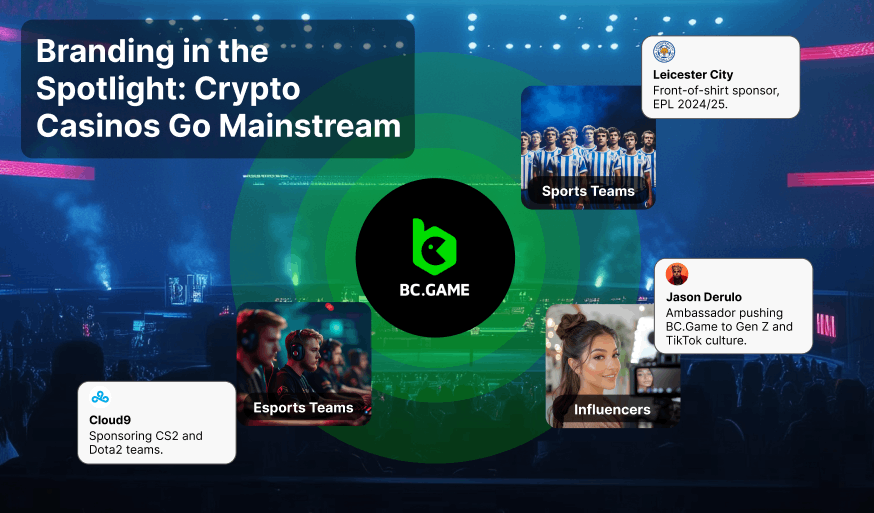
Sponsorships and partnerships with influencers also enable crypto casinos to effectively target their marketing efforts at specific demographics. For example, the popular crypto casino BC.Game has invested heavily in various sports and esports partnerships.
- Cloud9 - BC.Game sponsors both the CS2 and Dota2 teams of the California-based esports organization, helping to build brand recognition with a relatively young demographic.
- Leicester City - In July 2024, the brand announced it would be the front-of-shirt sponsor for English Premier League soccer team Leicester City.
- Jason Derulo - BC.Game has appointed the American singer, songwriter, and dancer as a brand ambassador, helping connect with a younger, mainstream audience.
When Sponsorships and Endorsements Backfire
Even though sponsorships and influencer marketing can be effective, it doesn’t always deliver a good ROI.
A certain casino I know of once spent several hundred thousand euros to sponsor a motor racing team for a season in a popular European event. The deal involved getting two race cars completely wrapped in graphics, having one of the drivers act as a brand ambassador, and generating plenty of opportunities for content creation - you know, videos of grid girls in catsuits emblazoned with the casino’s logo, dramatic drone footage of the cars speeding around the track, that kind of thing.
Again, it cost several hundred thousand euros for the sponsorship, and there were plenty of additional costs. For example, employee travel and accommodation (the races were in other countries), plus the cost of hiring promo models, drone operators, photographers, and videographers. And of course, for several months, the project took up a lot of staff working hours over several departments. However, when the dust had settled, the casino worked out it had only signed up around a dozen new players as a result of it all. Yep, you read that correctly - 12 new depositing players!
And, just to underline how partnerships and endorsements don’t always work, consider the 2024 US presidential election. According to the Daily Mail, Kamala Harris’ campaign spent $1 billion dollars, millions of which were spent on securing celebrity endorsements from the likes of Megan Three Stallion, Eminem, and Lizzo. But, she still lost the election to Donald Trump, by a landslide!
Challenges for Crypto Casino Marketing
Before we move on, it’s worth noting that marketing any online gambling, and especially crypto gambling, comes with its own set of regulatory headaches and other challenges. The subject is far too broad to cover here (maybe I’ll write a dedicated article about it soon), but in general, there are a few major challenges:
- How the cookie crumbled - In the old days of online marketing, tracking cookies could be used freely and liberally, making keeping tabs on affiliate referrals simple. But, in the era of GDPR and Consent-Based Marketing, both targeting specific web users and keeping tabs on referrals are more challenging.
- Advertising rules - In some countries, like the UK and Sweden, there are very strict advertising rules regarding pretty much everything - including online ads. When it comes to gambling and crypto, they are even stricter.
- Licensing - Some jurisdictions now require online gambling affiliates to be licensed, or at least registered, with regulators.
- Ad blockers - Again, in the old days, pop-ups and banners were extensively used by casino affiliates to market brands. They still are, but these days a large percentage of people use effective ad blockers as a matter of course, rendering such ads impotent.
- Ad fatigue - This is when potential customers see adverts too often and become bored, frustrated, or even angered by them. It has always been a problem to a degree, but online programmatic advertising has significantly exacerbated the issue.

Industry Partnerships
In addition to consumer-facing marketing and partnerships, successful online casinos also harness the power of business-to-business (B2B) collaborations. In the case of traditional online casinos, this is mainly with game providers, but crypto casino operators have even more options.
Game Providers
An interesting but often overlooked aspect of the online casino industry is how major casino operators often work closely with casino game developers. This symbiotic relationship manifests in several ways.
- Revenue Share - Although most players are unaware of it, many slots and other casino games are offered to casino operators on a revenue share basis. This makes offering a larger variety of games more affordable for the casino operator and also incentivizes game studios to make high-quality games.
- Exclusive Games - Most major crypto casinos now offer at least a few exclusive games. Sometimes, these are just casino-branded live blackjack and roulette tables, but other times specific slots will be developed exclusively for a specific casino. For example, casino game developer BGaming offers casinos services ranging from co-branded slots to deep customization and bespoke games.
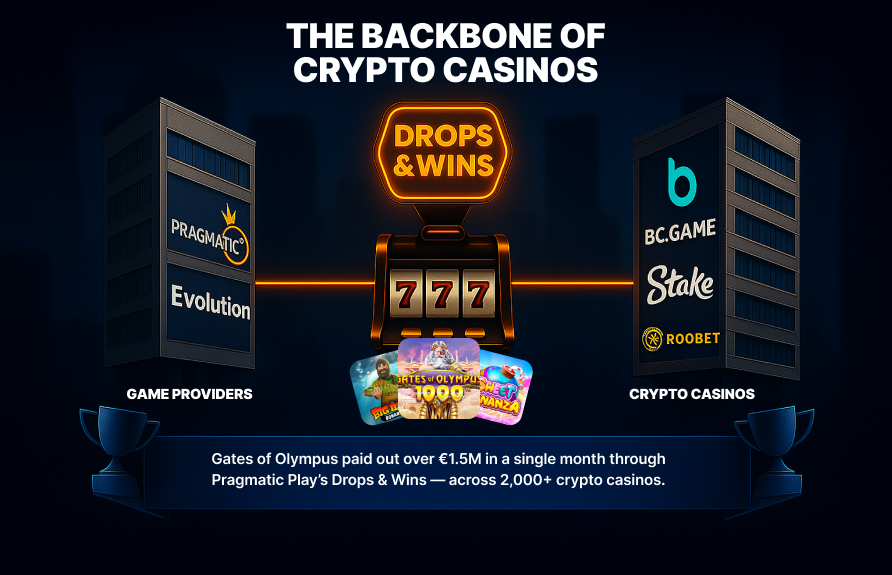
- Network Promotions - The biggest game providers often run network promotions, open to all the casinos that offer their games. These typically feature very large prize pools, helping the casino attract players while at the same time encouraging the casino to promote the provider’s titles.
Blockchain Integrations and DeFi Collaborations
When it comes to crypto casinos specifically, the integration of various blockchain and DeFi features can greatly increase the appeal of a platform.
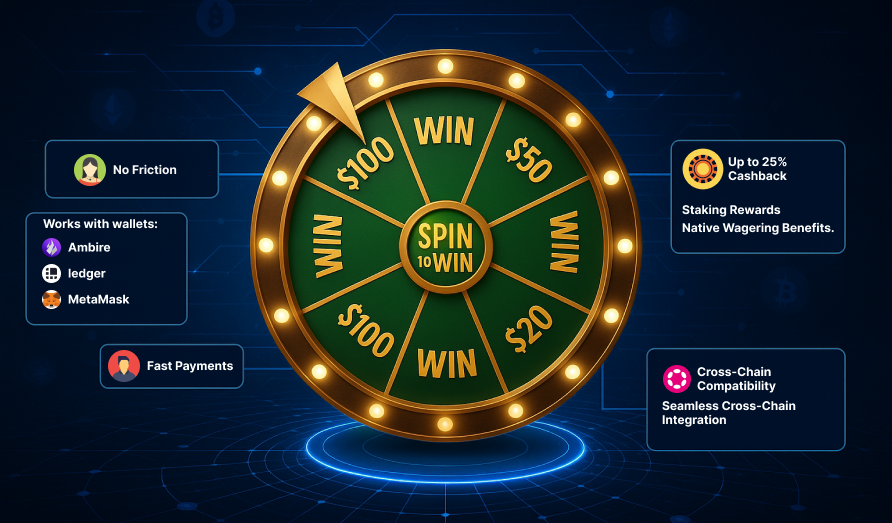
- Native Token Ecosystem - Several crypto casinos have launched their own crypto tokens and taken advantage of tokenomics. One of the most successful examples is TG.Casino with its TGC Token. Players receive various benefits for using TGC for wagering, including 25% cashback. Additionally, they can stake their tokens to earn revenue-based rewards.
- Web3 Wallet Integration - By integrating crypto wallets like MetaMask, Ledger, Fireblocks, Ambire Wallet, and others, crypto casinos can reduce user friction for both sign-up and payments. This also allows the gambling platform to be seamlessly integrated into a player’s wider Web3 user experience.
Cross-Chain Compatability - Fully decentralized online gambling platforms can significantly increase their potential market by integrating cross-chain operability. For example, by building on cross-chain projects like Polkadot and Cosmos Network, casino platforms can future-proof themselves for a truly Web3 world.
Licensing and Regulatory Considerations
One of the most challenging aspects of running any crypto casino or gambling platform is striking the right balance between regulatory compliance and competitiveness.
Crypto Casino Licensing Authorities
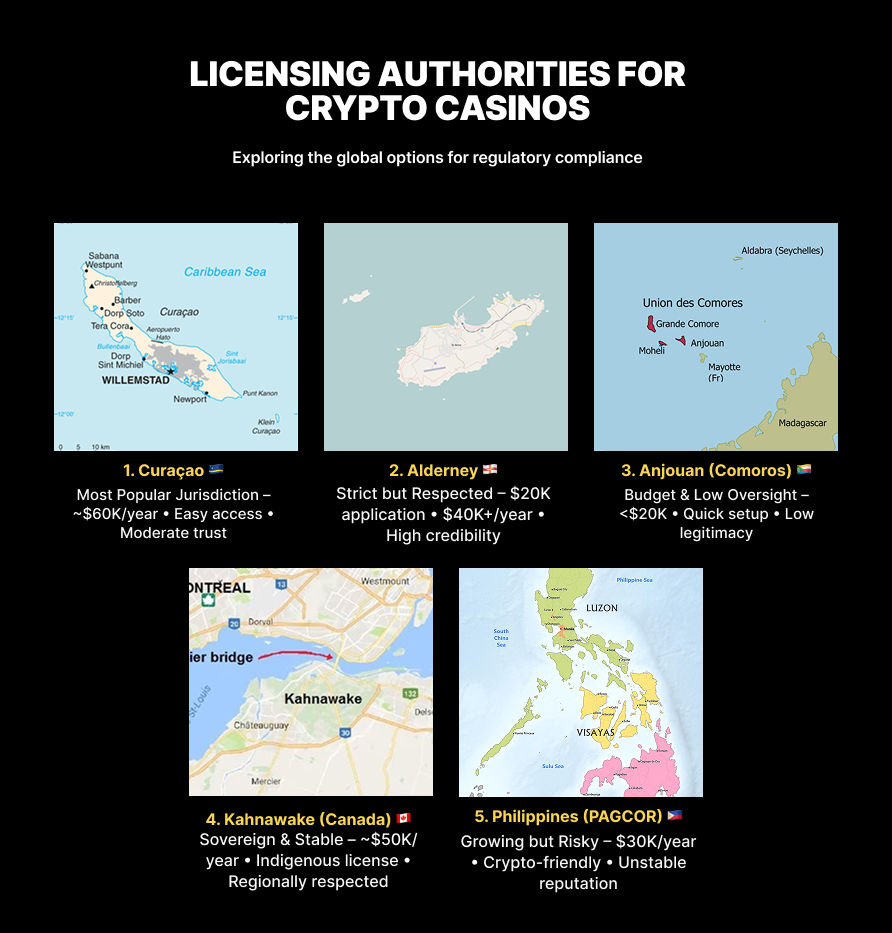
While getting licensed in one of the “gold standard” iGaming jurisdictions like the UK, Malta or Gibraltar might have many benefits for traditional online casinos, it’s not currently an option for crypto casinos. In fact, there are only a handful of licensing options available to crypto casinos.
- Curaçao Gaming Control Board (GCB) - In 2024, Curaçao began phasing out its old licensing system and replacing it with a much more robust one modeled on European frameworks. While it is one of the few jurisdictions that will license cryptocurrency casinos, compliance is now much more expensive and demands a physical staff presence on the island. While applying for a GCB license is relatively cheap, at just a few thousand euros, the annual cost of a license is upwards of $60,000. While some larger gambling operators have opted to stay, many smaller crypto casinos have moved to other jurisdictions.
- Alderney Gambling Control Commission (AGCC) - One of the smallest of the Channel Islands, Alderney is not part of the United Kingdom and has long issued its own online gaming licenses. Several crypto casinos currently have AGCC licenses, but the jurisdiction isn’t cheap. You will be looking at around $20,000 for the application, and $40K + annually.
- Anjouan (Comoros) - This autonomous volcanic island is part of the Indian Ocean nation of the Comoros. It has offered offshore gaming licenses for many years with very little success. However, since Curaçao tightened its rules, many crypto casinos have obtained Anjouan licenses. A license can cost under $20,000 and there is no requirement to have a physical presence in the jurisdiction. However, these licenses are widely regarded as extremely dodgy and provide zero legitimacy in the eyes of most players.
- Kahnawake Gaming Commission (KGC) - This Canadian tribal gaming authority has long been popular with traditional online casinos, and allows crypto gambling. To get a license, you’ll be looking at $50,000 + with annual renewal fees of several thousand euros.
- Philippine Amusement and Gaming Corporation (PAGCOR) - Many smaller crypto casinos have PAGCOR offshore gaming licenses. Application costs and annual fees are a little lower than Curaçao, coming in at around $30,000 each, but there are downsides. Philippine licenses don’t have the best reputation with players, and the country is notoriously unstable politically, with the gambling industry often being used as a pawn.
Compliance
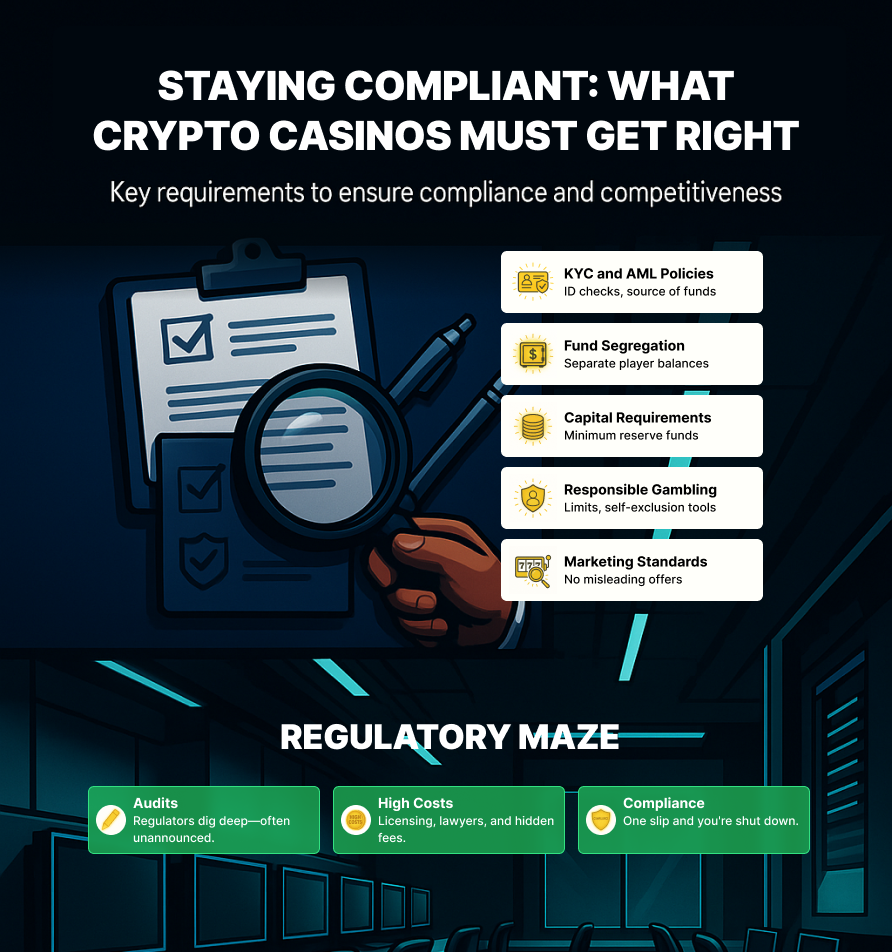
The practicalities and costs involved with ensuring compliance will greatly depend on the specific licensing authority involved. However, in general, regulators tend to stipulate the following:
- KYC and AML policies - Operators must have robust Know Your Customer and Anti-Money Laundering procedures in place. This includes things like identity checks and source of funds checks.
- Fund segregation - Operators may be required to keep player funds ring-fenced from operational funds. This is to ensure that, even if the casino becomes insolvent, player funds can still be returned.
- Capital - In some jurisdictions, casino operators must prove they have a certain amount of capital available to fund their operations.
- Responsible gambling - Some regulators require casino operators to comply with minimum safer gambling standards. For example, enabling players to set various limits and self-exclude.
- Game audits - Some regulators require operators to undergo regular audits by approved third-party testing labs (e.g. eCOGRA, iTech Labs, Gaming Associates) to ensure that stated game RTPs are accurate and fair.
- Marketing standards - In some jurisdictions, operators are required to comply with strict marketing guidelines. For example, not using content that is likely to appeal to minors or vulnerable people.
Crypto Specific Issues
If you’ve been in the crypto space for any length of time, you’ll know that many governments, lawmakers, and regulatory authorities tend to have issues understanding the space. Essentially, the realities of decentralization and trustless transactions are fundamentally incompatible with a great deal of current legislation. And, while things are improving in some jurisdictions, there are still an awful lot of grey areas.
So, when you add online gambling into the mix - a business that was already operating in a smorgasbord of widely different national and regional laws - things can get even more complicated. And, while there’s no magic solution to dealing with these issues, it is important to minimize risks where possible.
Ways to mitigate potential risks and liabilities:
- Operate offshore - Physically locate your operation in a jurisdiction that does have clear (or, at least relatively clear) crypto rules.
- Harness decentralization - Making use of fully decentralized platforms, that are not based anywhere and are owned/governed by geographically distributed stakeholders (for example a DAO), will make it hard for legal action to be taken against specific individuals.
- Diversify assets - Just like individual crypto investors should ensure they have a well-diversified portfolio, crypto casino operators should consider keeping their funds in a range of different fiat and digital assets.
Keep up to date - It sounds obvious, but the crypto and blockchain world moves so fast that it can be hard to keep up with the latest developments. But, as they say, “knowledge is power.” Often, in this space, you only find out what certain authorities deem acceptable or not when they arrest someone!
Organizational Structure: How Crypto Casinos Are Staffed
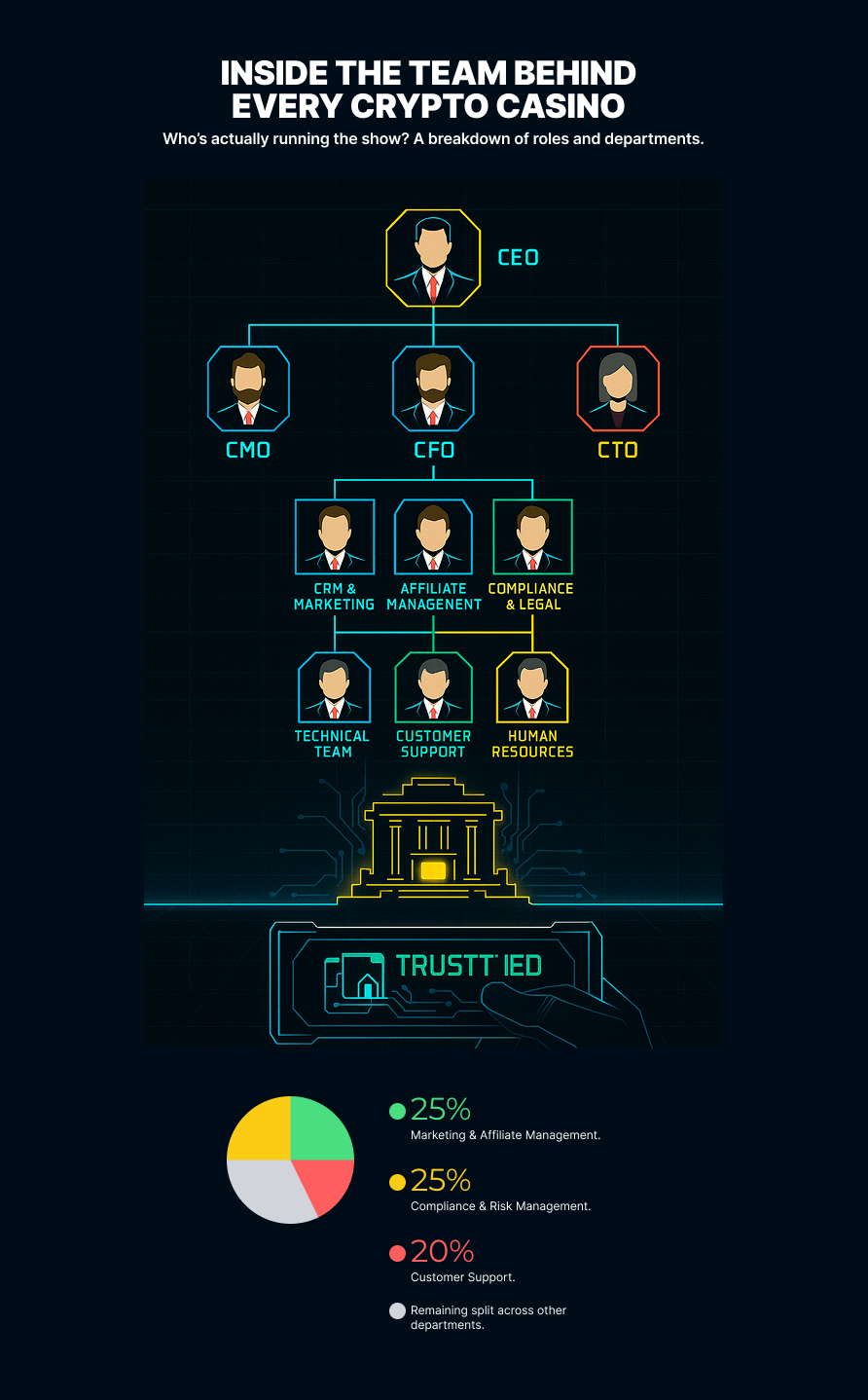
While fully decentralized crypto casinos don’t really have any staff in the traditional sense, hybrid crypto casinos (Stake, Gamdom, Bitstarz, etc.) are organized in much the same way as traditional online casinos. Key departments include:
- Executive - Like any large company, the C-level team (CEO, CFO, CMO, CTO, etc), makes the big decisions and is ultimately held responsible for everything.
- Compliance & Legal - For crypto casinos with licenses in relatively strict jurisdictions, this can be one of the most important departments. The compliance team is responsible for risk management, ensuring that all the required standards are maintained. This includes things like AML, KYC, and responsible gambling requirements.
- CRM & Marketing - This department is typically one of the busiest and includes those responsible for Customer Relationship Management, planning and running promotions and bonuses, and creating marketing content. Often, there will also be a PR specialist/s.
- Affiliate Management - Most large online casinos have dedicated staff to manage their affiliate marketing programs. These people liaise with and support individual affiliates, and ensure that standards are being maintained. They also represent the affiliate program at events and conferences.
- Customer Support - These are the staff on the frontline, who help players via live chat, email, and phone. Good teams will be highly trained, very familiar with the casino’s products, and able to deal with crises - for example, it’s not uncommon for them to find themselves talking with suicidal people and having to coordinate with police or other emergency services.
- Technical - This is the team that keeps everything running smoothly. Developers maintain and implement features, while security specialists ensure all the systems remain secure.
- Human Resources - Large crypto casino operators may have hundreds, or even thousands of staff, located both in offices and remotely. Often, staff will be located in multiple countries, making an efficient HR department critical to keeping things running smoothly.
- Accounting - Efficient and precise bookkeeping is important for any business, but things can get especially complex at online crypto casinos thanks to the many different currencies and jurisdictions involved. Good accountants and tax professionals are key personnel at any casino.
To give you an idea of staff distribution, a typical mid-sized crypto casino with 200 employees, serving 50,000 monthly active players may have around 25% of staff focused on marketing and affiliate management and 25% focused on compliance and risk management. The next biggest department is likely to be customer support.
Risk Management and Security
Crypto casinos devote substantial resources to risk management and security. And, this makes sense when you consider the kind of funds crypto casinos are often dealing with (remember, Stake.com alone generates billions of dollars of revenue annually). They are prime targets for all kinds of bad actors.
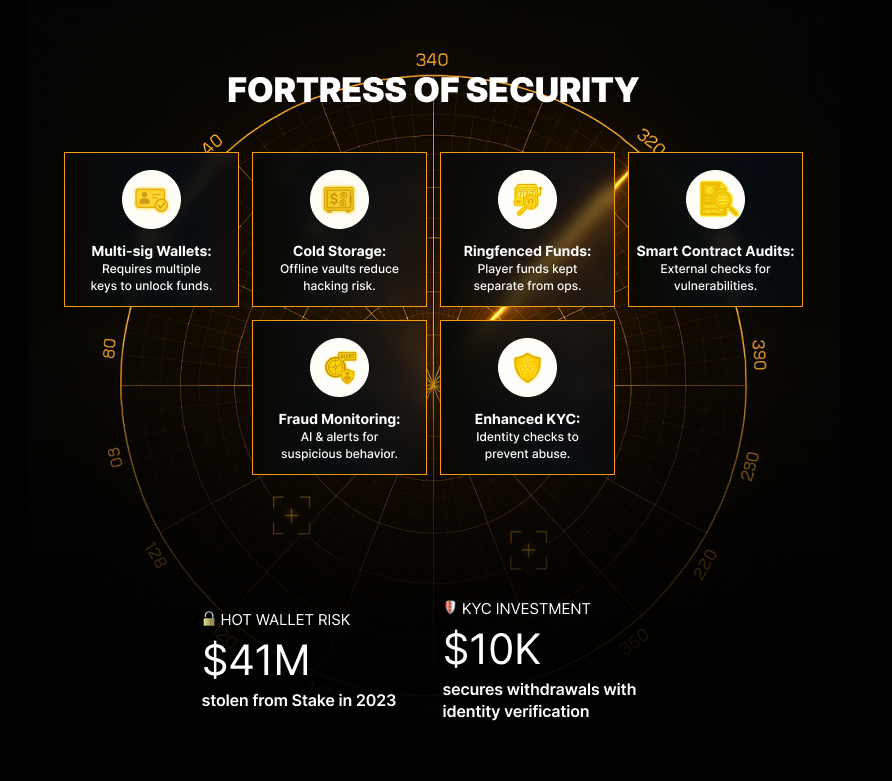
Key crypto casino security measures:
- Multi-signature wallets - This means that even if one signature is compromised (for example, in a “$5 wrench attack” - where a signature holder is physically attacked and forced to hand over their keys), no funds can be withdrawn improperly.
- Cold storage - Good crypto casinos will only keep enough crypto in hot software wallets to cover operational needs. Reserves will instead be transferred to cold storage in hardware wallets that are not connected to the internet and hence much safer. Illustrating just how important this is, in 2023, Stake lost an estimated $41 million worth of ETH, USDC, USDT, and DAI in a hot wallet exploit.
- Ringfenced funds - Player funds are kept completely separate from operational funds. This ensures that even if the casino business fails, it will be able to return balances to customers. It is a regulatory requirement in many jurisdictions.
- Smart contract audits - Although large blockchains are generally very safe, if a casino is developing and deploying its own tokens it's important to audit all smart contracts to ensure they don’t have any security vulnerabilities.
- Automatic fraud monitoring - Most online casinos use automatic systems to monitor and flag suspicious transactions. They look for various suspicious behaviors, like unusual deposit and withdrawal frequencies, unusual-sized deposits, deposits coming from multiple wallet addresses, and suspicious blockchain activity. Unfortunately, this can also lead to legitimate player accounts being suspended by mistake (see our guide for what to do if you are locked out of your crypto account for more on this).
- Enhanced KYC for high-value transactions - At most crypto casinos, players can make deposits and withdrawals up to certain limits without going through comprehensive KYC checks. However, for large withdrawals, virtually every crypto casino will conduct enhanced checks, requiring things like copies of official identification.
Financial Analysis of a Leading Crypto Casino
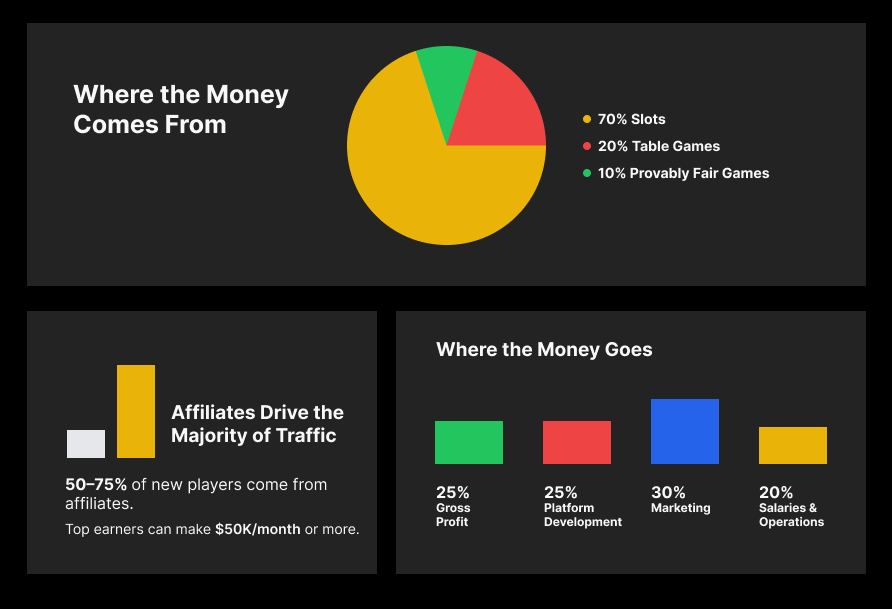
The opaque nature of the crypto casino industry means it isn’t possible to make a detailed case study of a leading crypto casino. But, from the information gleaned from various news reports, and the trends seen in traditional online casinos, it's possible to guestimate what things might look like.
Revenue and Player Numbers
- $10 million monthly revenue
- 70% of income from slots, 20% from table games (inc. live dealer games), and 10% from provably fair games
Affiliate Program Impact
- Affiliates contribute 50% - 75% of new player sign-ups
- High-performing affiliates earn up to $50,000 monthly
Profit Distribution and Expenses
- 25% gross profit
- 25% reinvested in platform development
- 30% allocated to marketing
- 20% covers salaries and operational costs
The Future of Crypto Casino Businesses
There’s no doubt that the online gambling industry is booming and cryptocurrencies are slowly but surely becoming mainstream. So, logic would suggest that the future is bright for the crypto casino business. And, generally, I think it is. Sure, there will be regulatory headaches and the odd panic during sharp crypto price drops, but on the whole, the benefits of crypto and decentralization are so significant that its dominance seems inevitable.
The real unknown is exactly what form of crypto-gambling platforms will come to dominate the industry. Will it be the Stakes, Gamdoms, and Bitstarz of the world - hybrid platforms that adopt decentralized elements but are still run by traditional companies - or will it be completely decentralized platforms run by DAOs (Decentralized Autonomous Organizations)? On the one hand, today’s major crypto casinos provide a more accessible user experience and a bigger product range than fully decentralized platforms. But, on the other, the user experience and choice offered by fully decentralized options are rapidly improving. In reality, we’ll likely see a mix exist for a while, but my gut feeling is that fully decentralized platforms will eventually dominate.
So, what will that mean for crypto casino entrepreneurs, investors, and affiliates? Well, there will still be plenty of opportunities for all three. But, instead of entrepreneurs and investors being involved with a single crypto casino operating company, they will be stakeholders in numerous decentralized projects. Affiliate programs will also be increasingly automated, and affiliates will be paid in the native tokens of the sites they promote, rather than cash (in turn giving them a stake in the ownership too).
Of course, this evolution might well take a long time, and we will likely see a mix of traditional, hybrid, and fully decentralized online gambling platforms for many years. But, whatever happens, I think it’s almost certain that the traditional structure of online casinos and affiliate marketing is going to alter significantly. In the meantime, if you’re thinking of getting involved in the crypto casino industry, either as an operator or an affiliate, I’d give you two pieces of advice:
- Don’t hang around - it’s always been a fast-moving space but things are accelerating
- Do your research and consult experienced professionals before investing
- Always under-estimate revenue and over-estimate costs
I hope you’ve found this original CoinBets guide interesting, and if you’ve got any questions, comments, or experiences you’d like to share, feel free to reach out.