





 Continue with Apple
 Continue with Google
Locked Out of Your Crypto Casino Account? How to Recover Access and Retrieve Your Funds
The emergence of crypto casinos has brought many benefits to online gamblers, including more privacy, faster transactions, and provably fair games. However, it’s also given rise to some unique challenges, particularly regarding unjustified account closures. Indeed, precisely because crypto casinos are more decentralized and less regulated, resolving disputes arising from account suspensions or fund freezes can be difficult.
In this original CoinBets guide, I’ll look at the issue of wrongful account closures and their common causes. I’ll also share some best practices for avoiding problems in the first place, and some tips for solving them if the worst does happen. So, if you're looking for a step-by-step roadmap to recover your account and funds, keep reading.
Crypto-Specific Causes for Casino Account Closures
All legitimate online casinos, whether traditional, crypto, or hybrid, have policies to prevent fraud and reduce the likelihood of money laundering and other malicious activities. Of course, the robustness of these policies will vary between casinos, with those in certain jurisdictions being much stricter (for example, casinos licensed by the UK Gambling Commission and Malta Gaming Authority).
The problem is that making cryptocurrencies, decentralized finance (DeFi), and other blockchain technologies compatible with existing regulations can be challenging. Unfortunately, this often leads to wrongful account closures. So, let’s run through some of the main issues:
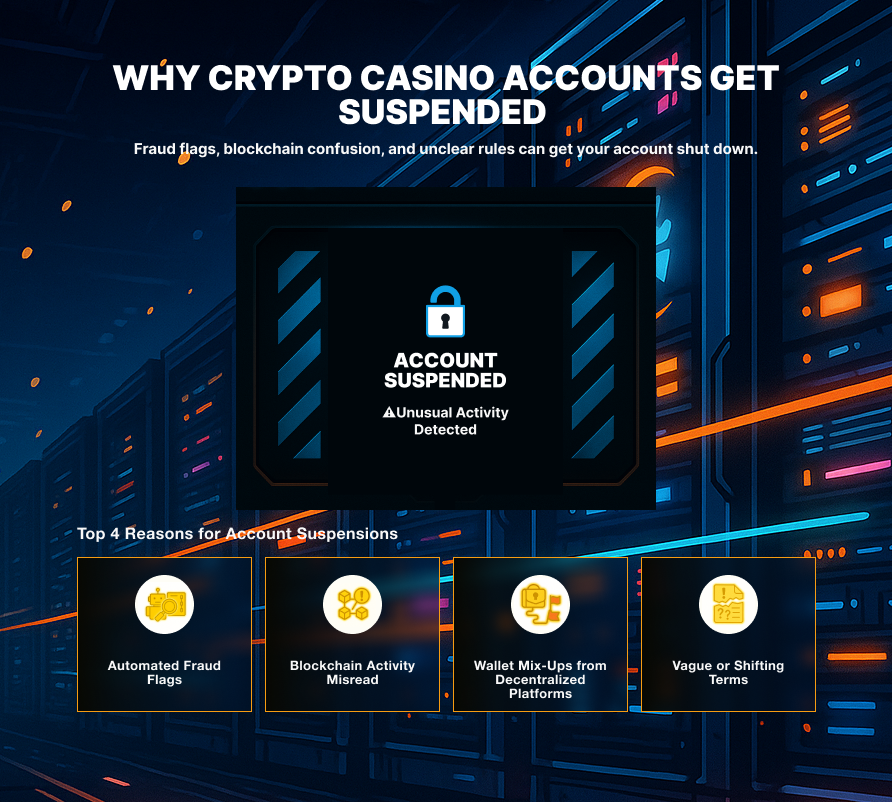
Automated Anti-Fraud Measures
Due to the huge numbers of customers large crypto casinos serve, they often rely on automated anti-fraud systems to monitor transactions. Just like large or unusual transactions can cause your bank or credit card company to temporarily block your card (for example, if you go on holiday, or buy an expensive gift), large or frequent cryptocurrency transfers, especially if originating from multiple wallets, can trigger automatic red flags.
Like other businesses, crypto casino operators usually err on the side of caution when setting parameters, resulting in automatic systems frequently misinterpreting legitimate activity as fraudulent. Typically, these suspensions are temporary and can be resolved relatively quickly.
Misinterpretation of Blockchain Activity
One of the key benefits of crypto transactions is that all activity is recorded on public ledgers. This is critical to maintaining transparency and maintaining trust in any crypto ecosystem. However, the transactions recorded on blockchains do not provide much in the way of context, and so unusual patterns - for example, a sudden influx of funds or high-value deposits from an anonymous wallet - can be misinterpreted as suspicious, even if perfectly legitimate.
Decentralized Features and Wallet Confusion
Occasionally, using non-custodial wallets and decentralized features, like token swaps and staking, can create discrepancies between the actual on-chain activity and a casino’s internal tracking system. These mismatches can also trigger unwarranted account suspensions or closures.
Unclear or Inconsistent Policies
Okay, here’s one of the most common causes of unjust account suspensions and closures, and it’s incredibly frustrating for players. Far too often, crypto casinos have vague, inconsistent (and sometimes, flat-out contradictory) terms and conditions. This is particularly common regarding transaction limits, KYC (Know Your Customer) requirements, and what is deemed acceptable wallet activity. Confusion caused by poorly defined or inconsistently applied rules and procedures can cause wrongful account suspensions and closures.
What to Do If Your Account is Closed: The Step-by-Step Guide
Righty, so you’ve just made a coffee and opened your laptop to enjoy a few spins on your favorite slot. But, you can’t log in. Instead, you get a notice that your account has been suspended.
- Don’t PanicKeep
calm, continue drinking your coffee, and check your email for any communications from the casino. The best crypto casinos will provide details for account closures/suspensions and outline the steps you can take to resolve the situation. - Take Inventory
Establish what your casino account crypto balance should be and take note of any recent transactions. - Review Casino Policies
Before you take further action, carefully read through the casino’s Terms and Conditions and User Agreement. Pay particular attention to the sections covering account closures, KYC compliance, and blockchain-related rules. - Document Relevant InformationCollect
information that may be useful. If possible, save screenshots of your account activity, transaction history, error messages, and any recent communications you may have had from the casino support team. - Gather Blockchain
EvidenceCollate your wallet transaction hashes and other blockchain evidence to verify your casino deposits and withdrawals.
Creating an Effective Support Request
Unless the casino’s support team has already given you clear directions to resolve the situation, the next step will be to submit a support request. Sounds simple, right? Well, taking the time to craft a well-rounded support request can significantly increase your chances of resolving the problem quickly. Here are some tips:
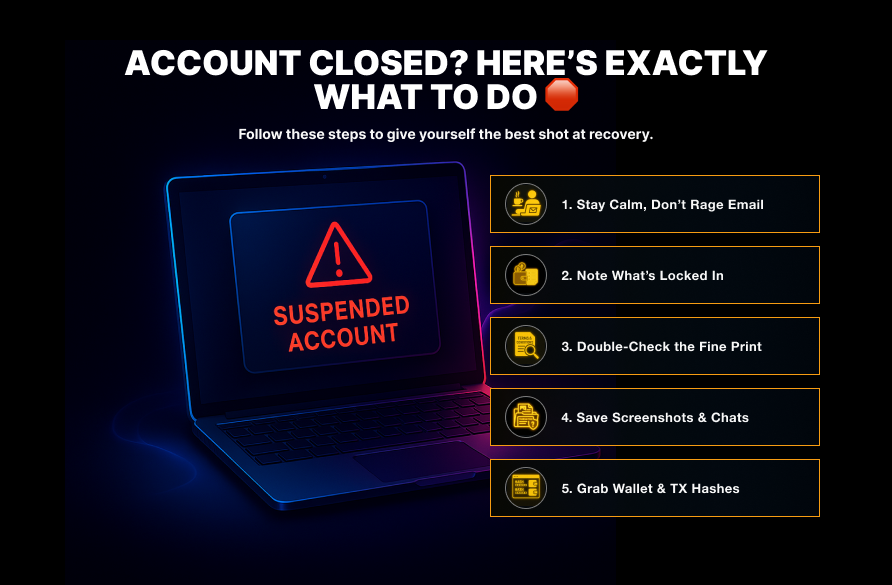
- Remain Polite and
CalmRemember, the staff member who initially reads your request is a human being just trying to earn a living, and they have most likely had nothing to do with the suspension of your account. Being nice will make it more likely that they go that extra mile to help you. - Structure Your Message Clearly
Don’t just throw together a message. Draft it, check it, and redraft it until it is as clear and concise as possible. Avoiding confusion and misunderstandings at this stage is critical if you want a speedy resolution. Outline the issue concisely and factually, attach relevant evidence (like screenshots and blockchain info), and ask if there is anything else you can provide to help. - Do Not Make Accusations
No matter how angry or frustrated you are, do not make any accusations at this point. Remember, at this stage, it is still very likely that the issue was caused by an automated system and can be quickly resolved. If you escalate things unduly, it could make your situation worse.
Steps to Escalate in the Crypto Space
Hopefully, your problem will have been solved, and you won’t need to escalate things further. But, if you can’t make any progress, then it is time to turn things up a notch.
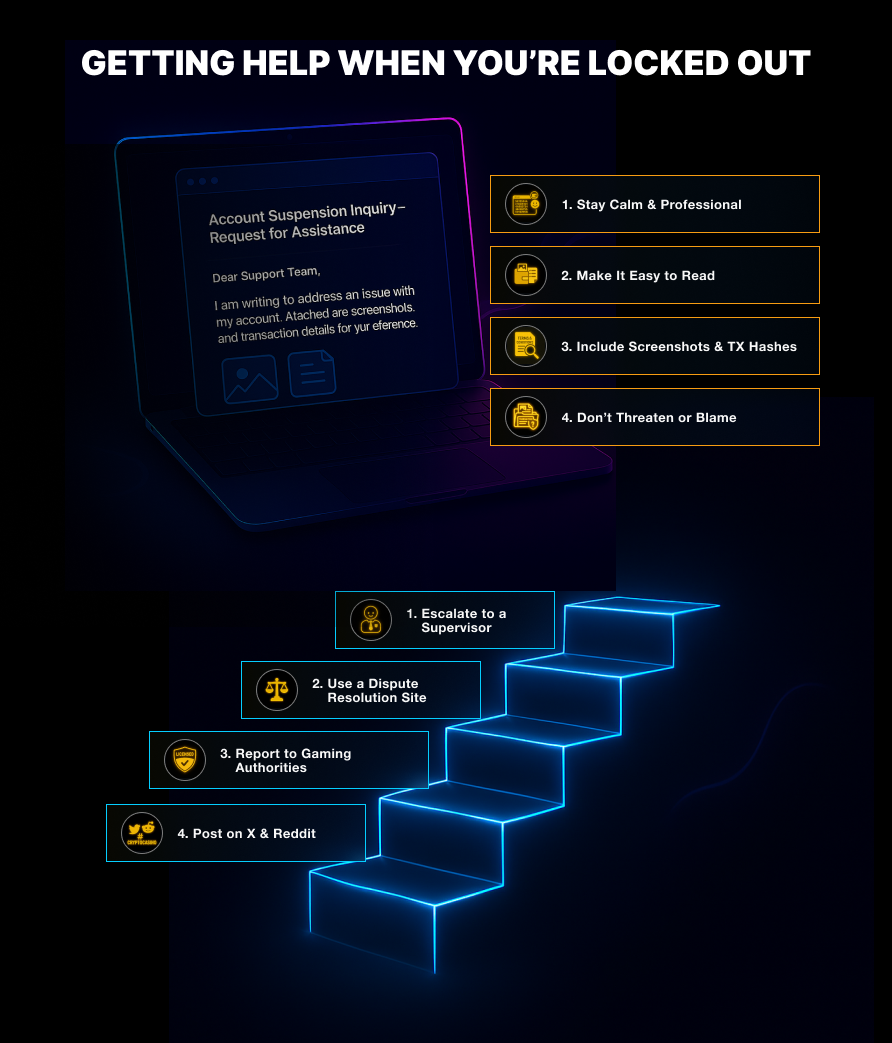
- Request Higher-Level Support
Ask for your case to be escalated to a supervisor or specialized crypto support team if there is one. Be sure to provide a summary of all prior communications, and your evidence, to any new representative you are passed to. Again, remain polite and calm. - Third-Party Arbitration
If you are getting nowhere with the casino directly, Alternative Dispute Resolution (ADR) services may be able to help. ADR services are available via large online gambling community sites, like CasinoMeister, while in some gambling jurisdictions, like the UK, casino operators are required to work with an approved ADR like IBAS or eCOGRA. However, you are unlikely to find ADRs listed on crypto casino sites. - Contact Licensing Authorities
How effective it is will depend largely on the regulatory body in question. For example, many crypto casinos are licensed by the Curaçao Gaming Control Board (GCB), whose website specifically states “Please note that the GCB does not handle disputes between players and gaming operators.” On the other hand, the Kahnawake Gaming Commission (KGC) expressly offers player protection and dispute resolution services. - Leverage the Crypto Casino Community
If the casino is still not willing to resolve the issue, you may want to consider reaching out to the wider crypto community. Sometimes, just the specter of publicly posting about your experience on platforms like BitcoinTalk, crypto gambling subreddits, specialized forums, and social media is enough to get results.
Making Your Case Public in the Crypto Community
If you do decide to go public with your crypto casino account suspension experience, there are some things you should keep in mind:
- Be Factual and Objective
Stick to the the facts, include evidence, and try to remain objective. This will result in people being far more receptive and willing to help you. If you share on social media like X (Twitter), be sure to use appropriate hashtags like #CryptoCasino and #BlockedAccount. - Share Evidence Safely
While including evidence like screenshots and blockchain transaction evidence is very useful, you should be careful not to publish any sensitive personal information. Check all screenshots and documents carefully and blackout any such data before posting. - Engage with the Community Respectfully
Frame your posts as asking for advice and support from the crypto gaming community, rather than as outright attacks on the casino in question. And, of course, don’t let trolls get under your skin. - Amplify Your Story
Even though the issue may be of huge concern to you personally, don’t get disheartened if it seems like others aren’t interested at first. Everyone has their own life dramas going on. When posting on social media like X (aka Twitter), make sure to include relevant hashtags like #CryptoCasino and #AccountBlocked.
Legal Avenues for Crypto Users
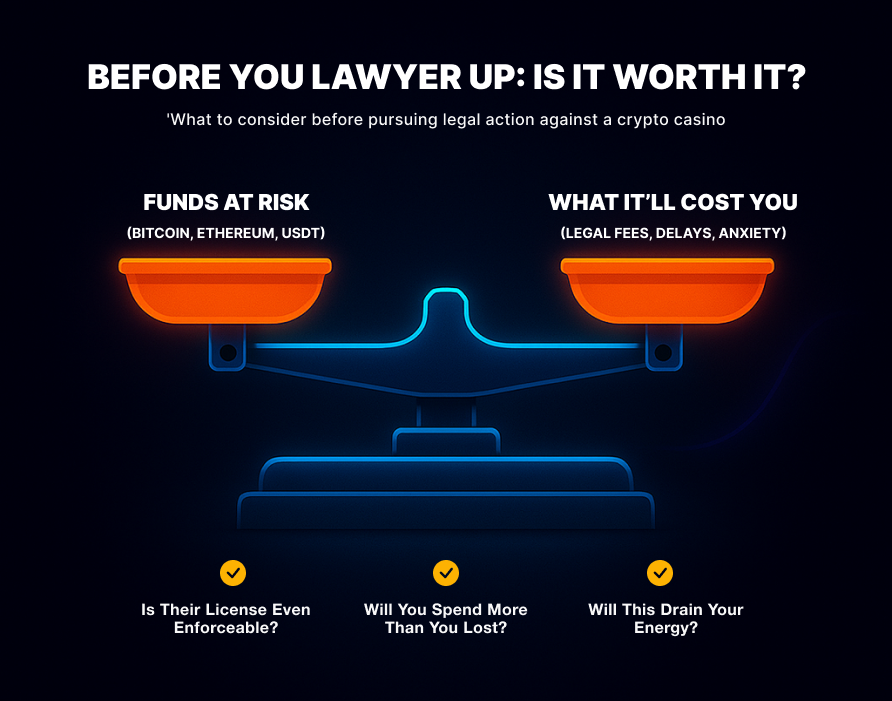
If you’ve done everything and are still having no success, the final avenue left open to you may be some kind of legal action. However, before you do anything, you should ask yourself the following questions:
- Is the casino based in a jurisdiction where legal action will be viable or likely to succeed?
For example, legal action may be possible against an operating company based in Curaçao or Estonia but is highly unlikely to be realistic against a casino licensed in Anjouan (Comoros). - Is the value of the funds you have lost worth the cost of legal action?
Even if legal action is possible, it will probably be very expensive and take a long time. Are the crypto funds in question valuable enough to justify the cost, in both time and money, of legal action? - Is the issue worth the stress of pursuing legal action?
If you’ve ever been involved in a legal dispute, you’ll know it can be extremely stressful. Is the issue worth the anxiety it will probably cause?
In 99% of cases, unless the value of the crypto in your locked casino account is extremely high, it’s not going to justify the cost, time, and stress of pursuing legal action. And, considering the jurisdictions most crypto casinos are based in, even if you won a legal battle in the courts, getting judgments enforced would be far from assured.
Still, if you do decide to pursue legal action against a crypto casino operating company, you should try to find a law firm that specializes in blockchain and cryptocurrency cases. Most traditional law practices simply won’t have the expertise to interpret complex on-chain evidence and understand the nuances of crypto regulations.
Proactive Measures to Avoid Problems
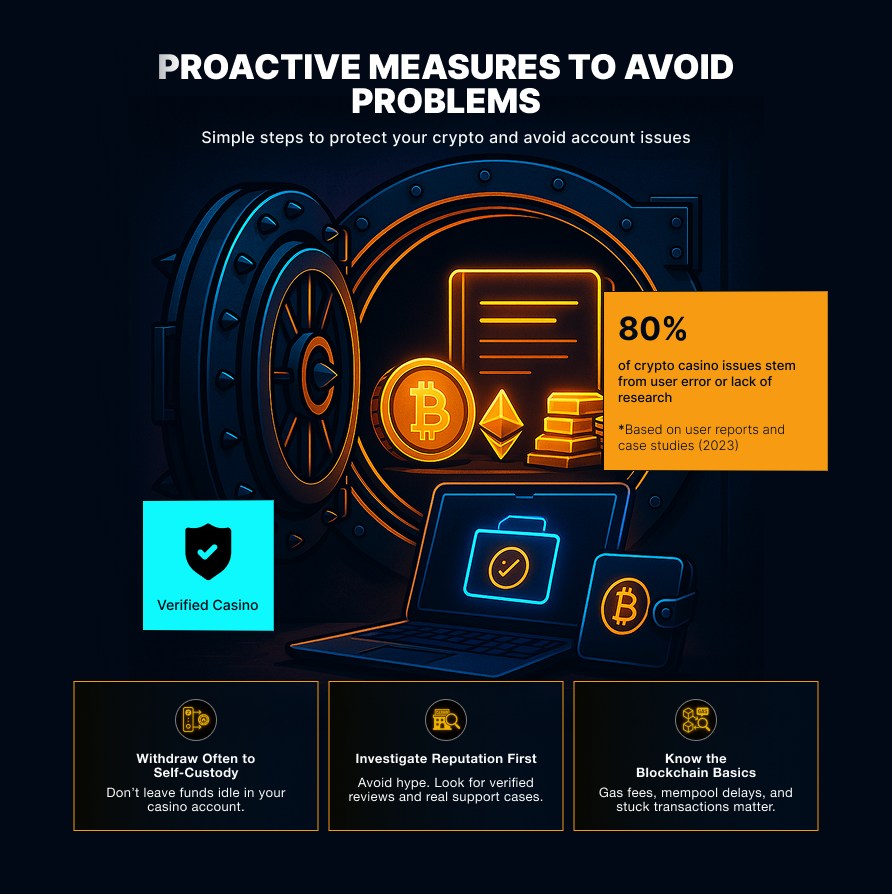
As with most things in life, when it comes to crypto gambling, preventing problems is better than trying to cure them. Fortunately, there are several easy things you can do to avoid crypto casino account problems - or, at least make them easier to fix if you do run into them.
Keep Your Crypto Safe
The easiest way to ensure your crypto doesn’t end up trapped in a casino account is simply not to leave it there. In the same way that you shouldn’t leave a lot of crypto on exchange-based wallets (remember the FTX disaster), you should avoid leaving large amounts of crypto in your casino wallets. Leave enough for your immediate needs, but then withdraw the rest to a secure non-custodial wallet. Get into the habit of withdrawing your winnings regularly.
Research a Casino Before Depositing
It sounds obvious, but it’s easy to be blinded by some incredible-looking crypto casino welcome bonus. Always carefully research a crypto casino’s reputation before signing up and making your first deposit. Of course, the best way to do that is to read the reviews right here on CoinBets - we are brutally honest!
Of course, this being planet Earth in the 2020s, there are a lot of crypto casino “reviews” and “educational” articles that you should either take with a pinch of salt or ignore completely. To help you spot this kind of thing we’ve published the CoinBets guide to Spotting Fake or Dodgy Crypto Casino Reviews and Marketing Content.
Familiarize Yourself with On-Chain Dynamics
Before you jump into the world of online crypto gambling, make sure you understand the basics of how crypto and blockchains work. As previously mentioned, crypto casinos will often contain specific points regarding gas fees, wallet transfers, and other blockchain activity. Checking all this out before you deposit any crypto will help you avoid doing anything that may get your account flagged in the future.
Final Thoughts About Crypto Casino Account Suspensions
At the end of the day, the issue of wrongly flagged and suspended accounts isn’t unique to crypto casinos. As businesses across many sectors introduce more checks to combat rocketing fraud and comply with ever-stricter regulations, more accounts will inevitably get wrongly flagged and suspended. The issue can just be more problematic in crypto gambling because of the added complexities resulting from decentralization and conflicting (or non-existent) regulation.
However, account closure problems are still relatively rare, and you can reduce the risk of running into issues by following the best practices I’ve outlined in this article. As with all things in the rapidly evolving crypto space, the key is to stay informed and to avoid problems developing. In a nutshell, minimize your risk exposure, and avoid engaging in activity that someone (or some computer) could interpret as “dodgy.”
Above all, keep perspective and avoid unnecessary paranoia. Most people never get locked out of their crypto casino accounts, and even if they do, the problems are normally resolved quickly. So, I’ll sign off now, but I hope you’ve found this original CoinBets guide useful, and as always, feel free to share your relevant experiences below.